Zero Commission vs Traditional Food Ordering Models
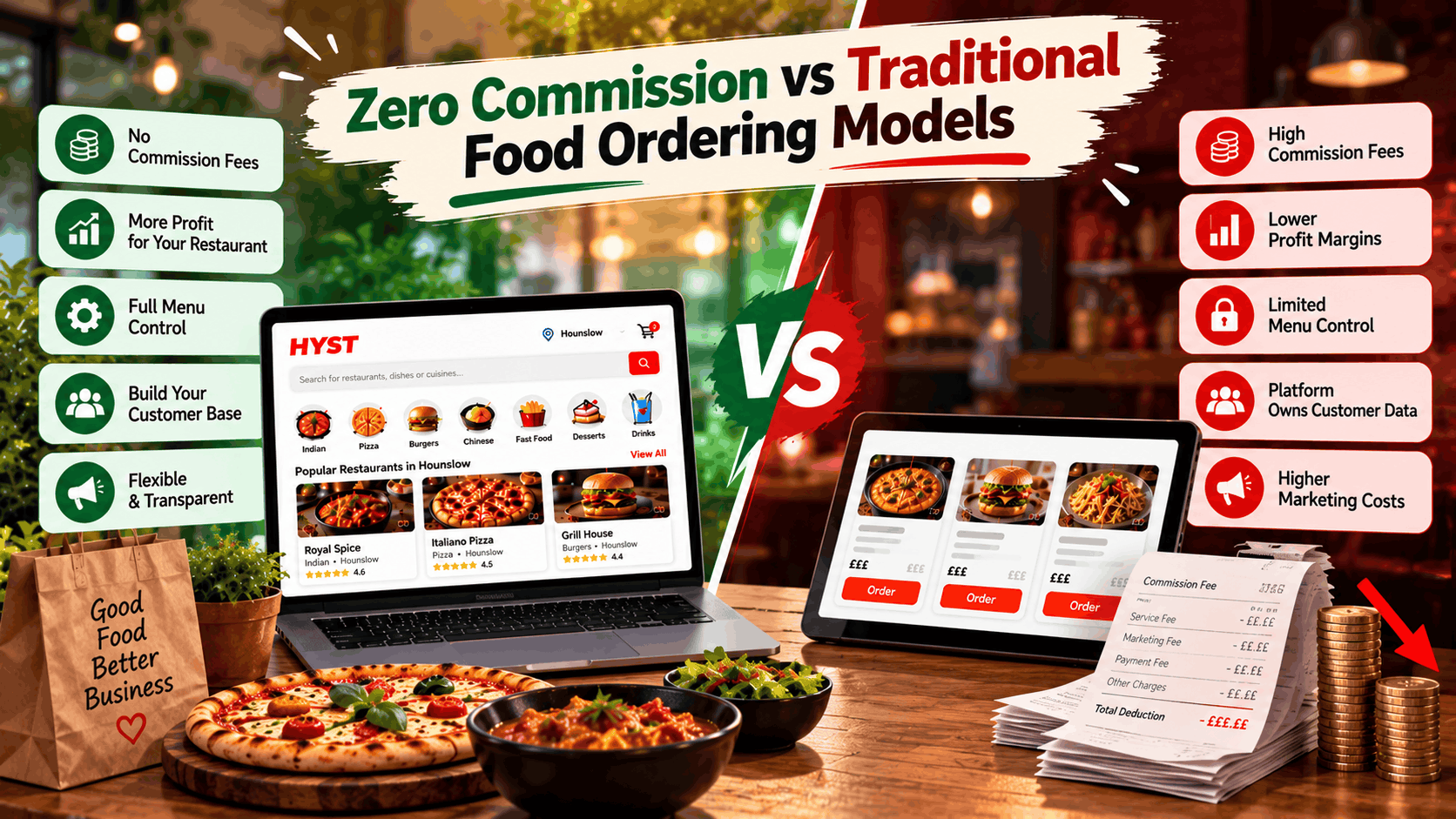
Choosing the right online ordering model is an important business decision for independent restaurants, cafés and takeaways. Platforms such as HYST provide an alternative to consider for restaurants exploring direct online ordering and a zero-commission model for participating partners. Before choosing any platform, restaurant owners should understand how commission, payment processing, delivery, marketing and other operating expenses affect the money retained from each order.
Online food ordering can help restaurants reach customers who discover food businesses through search engines, websites and digital marketplaces. However, the number of orders alone does not tell the full story. Restaurant owners also need to understand the cost of generating and fulfilling those orders.
This is particularly important for independent restaurants in Hounslow, London and across the UK, where business owners must balance customer convenience, visibility and profitability.
1. What Is a Traditional Food Ordering Model?
In a traditional third-party marketplace model, a restaurant lists its menu on a platform that helps customers discover restaurants and place food orders.
Depending on the provider and agreement, the platform may charge commission, service fees or other costs. Delivery, payment processing, advertising and promotional expenses may also affect the restaurant's overall economics.
The specific charges vary by platform, contract, location and service. Restaurant owners should always check the actual commercial terms rather than assume that every provider uses the same pricing structure.
Traditional marketplace models may provide access to an existing customer audience. Restaurants should assess the value of that reach alongside the fees and conditions attached to it.
2. What Does Zero-Commission Food Ordering Mean?
A zero-commission model generally means that a participating restaurant does not pay a percentage-based marketplace commission on qualifying orders under the applicable agreement.
This can change the financial calculation for an independent restaurant.
However, zero commission does not necessarily mean that every part of an order is free. Payment processing, delivery, packaging, ingredients, staff time, marketing or other applicable charges may still need to be considered.
HYST's restaurant partner programme promotes a zero-commission model for participating restaurant partners, while its terms explain that the specific commercial arrangements are set out in each partner's agreement.
Restaurant owners can also explore HYST's explanation of zero-commission food ordering.
3. Understand the Difference Between Commission and Total Cost
One of the most common mistakes in restaurant financial planning is comparing platforms using only the headline commission rate.
A more useful comparison considers the complete cost of fulfilling an order.
For example, suppose a restaurant receives an order worth £30. Its actual contribution depends on the cost of the food, packaging, payment processing, delivery and any applicable platform charges.
The restaurant should calculate:
Order revenue − food cost − packaging − payment processing − delivery cost − applicable platform fees = contribution from the order
This is a simplified calculation; staffing, rent, utilities, tax and other business expenses may also need to be considered when assessing overall profitability.
The purpose is to understand the financial result of each ordering channel rather than focus on one fee in isolation.
4. Example: Comparing Two Ordering Models
Consider a hypothetical £30 restaurant order.
<text color="secondary" size="sm">Illustrative figures only — not actual HYST fees or a quote from any ordering platform.</text>
| Item | Model A: 20% commission | Model B: 0% marketplace commission |
|---|---|---|
| Order value | £30.00 | £30.00 |
| Marketplace commission | £6.00 | £0.00 |
| Revenue after marketplace commission | £24.00 | £30.00 |
In this simplified example, Model B leaves £6 more before considering other expenses.
However, the restaurant must still compare payment processing, delivery, marketing, customer acquisition and any other charges under each model. The final financial outcome depends on the actual agreement and the costs associated with each channel.
This is why restaurant owners should compare total cost and contribution per order, not just the advertised commission percentage.
5. How Traditional Platforms Can Help Restaurants
A traditional marketplace may provide access to customers already using the platform to discover food businesses.
This can be useful for restaurants seeking visibility among people who are not yet familiar with their brand.
Depending on the provider, restaurants may also have access to ordering tools, delivery arrangements, promotional options and order-management features.
The important question is whether the value received justifies the total cost.
Restaurants should examine the orders generated, the revenue retained, the operational workload and the quality of the customer experience before deciding whether to continue using a particular channel.
6. Potential Advantages of Zero-Commission Models
A zero-commission model may reduce one category of cost for participating restaurants when compared with a commission-based agreement.
Potential considerations include:
- More revenue retained before other expenses
- Greater attention to direct ordering
- Menu and price management
- An additional route for online restaurant discovery
- Opportunities to build a recognisable restaurant brand
The actual benefits depend on the terms of the platform and how well it fits the restaurant's operations.
For example, a restaurant may still need to invest in local marketing to help customers discover its online menu. A zero-commission structure alone does not guarantee orders or profitability.
7. Compare Menu Control and Restaurant Flexibility
Menu management is an important part of operating an online restaurant business.
Restaurants may need to change prices, update dish descriptions, add menu options, remove unavailable products or adjust opening hours.
Before selecting an ordering platform, owners should check how easily they can make these changes and how quickly the information becomes visible to customers.
HYST's restaurant ordering FAQs describe menu, pricing and availability controls for participating partners.
Accurate online menus can help reduce confusion and give customers a clearer understanding of what they are ordering.
8. Evaluate Delivery and Payment Arrangements
Commission is only one part of an ordering decision.
Restaurants should also understand how payments are processed, when payouts occur, who handles delivery, which delivery charges apply and how order problems are resolved.
Questions to ask include:
- Are there payment processing charges?
- Who arranges delivery?
- Are delivery charges separate?
- How are refunds and cancellations handled?
- When does the restaurant receive its payout?
- What support is available for order issues?
- Are there any additional service fees?
The answers should come from the provider's current documentation and the restaurant's actual agreement.
9. Consider Customer Relationships and Repeat Orders
Different ordering models can affect how restaurants interact with their customers.
Restaurants should understand what customer information is available, how it may be used and which privacy restrictions apply.
They should not assume that joining a marketplace automatically gives them unrestricted access to customer contact details or permission to market directly to every buyer.
Long-term customer relationships can also be supported through accurate menus, consistent food quality, reliable service and an easy ordering journey.
10. Which Model Is Better for Independent Restaurants?
There is no single answer that suits every restaurant.
A commission-based marketplace may be useful when it provides valuable customer reach or services that would be difficult for the restaurant to arrange independently.
A zero-commission model may be worth considering when the restaurant wants to reduce percentage-based marketplace fees and has a suitable way to attract and serve customers.
Some restaurants may decide to use more than one channel, provided the combined economics and operational workload make sense.
The decision should be based on:
- Customer reach
- Total fees
- Revenue retained
- Delivery arrangements
- Payment processing
- Menu control
- Customer experience
- Marketing requirements
- Operational workload
- Contractual terms
11. Calculate Profitability Before Making a Decision
Restaurant owners can compare ordering models using their own sales and cost data.
For each channel, record the order value, food costs, packaging, payment charges, delivery expenses and applicable platform fees.
Then calculate the contribution from each order and compare the results over a reasonable period.
Also consider order volume, customer acquisition and repeat business. A channel with lower fees but very few orders may produce a different business outcome from a channel with higher fees and substantial customer demand.
The goal is to identify a model that supports sustainable business performance rather than choose solely on the basis of one advertised feature.
12. Avoid Misleading Comparisons
Restaurant owners should be cautious of claims that any model guarantees more orders, higher profits or a particular search-engine ranking.
A fair comparison should use the current contract, accurate costs and realistic expectations.
A zero-commission model can remove a percentage-based marketplace commission under the relevant agreement, but it cannot remove every operating cost associated with preparing and delivering food.
Likewise, a traditional marketplace's commission should be evaluated against the services, customer reach and other benefits it actually provides to the restaurant.
Conclusion: Choose the Ordering Model That Fits Your Business
Zero-commission and traditional food ordering models can offer different advantages depending on the restaurant's needs.
The right decision requires an understanding of customer reach, commission, payment processing, delivery, menu control, marketing expenses and the complete cost of fulfilling each order.
For independent restaurants in Hounslow and across the UK, online ordering should be evaluated as a business channel, not simply as a way to receive more transactions.
HYST is one option for restaurants exploring a zero-commission approach for participating partners. Before making a decision, owners should compare the model against their own requirements and review the current HYST terms and conditions.
Ultimately, the best ordering model is the one that helps the restaurant serve customers effectively while supporting sustainable, measurable business performance.