What Does Zero-Commission Food Ordering Mean for Restaurants?
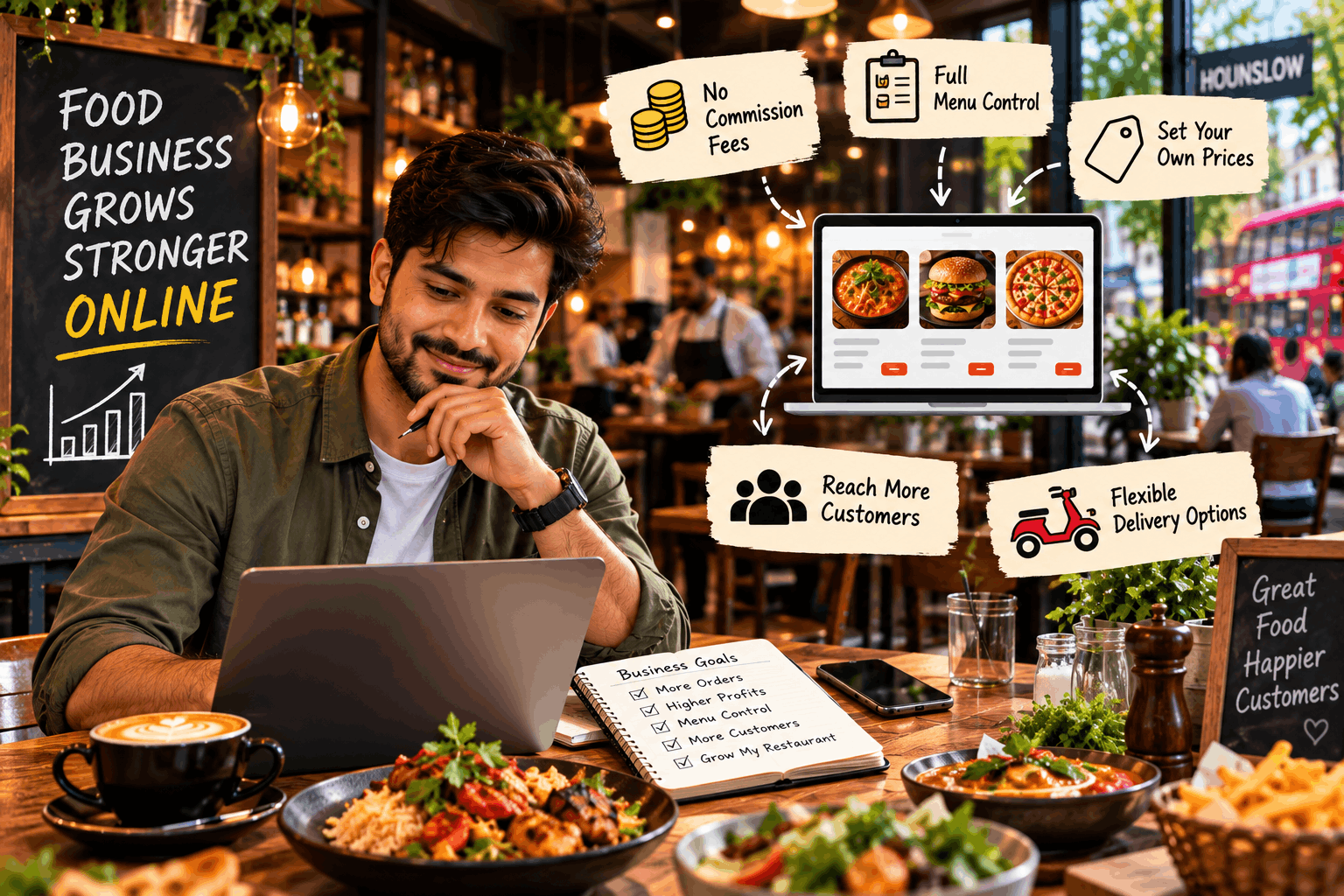
For independent restaurants, online ordering has become much more than a technical extra. It is now an important part of how customers discover restaurants, browse menus, compare prices, order food online and arrange takeaway or delivery. As the UK food delivery market continues to become more digital, restaurant owners are increasingly looking at different online restaurant ordering platforms and asking an important question: what does zero-commission food ordering actually mean for restaurants?
For restaurants exploring alternative ordering models, platforms such as HYST provide another option to consider, with a focus on direct ordering and a zero-commission model for participating restaurant partners. HYST's current partner information also highlights direct customer relationships and menu and price control.
What Is Zero-Commission Food Ordering?
In simple terms, zero-commission food ordering refers to an ordering model where a participating restaurant does not pay a percentage-based marketplace commission on qualifying orders under the applicable commercial agreement.
Traditional third-party food delivery platforms can charge restaurants commissions or other fees for providing access to customers and ordering technology. For an independent restaurant, these costs can become an important part of the overall economics of online food delivery.
A zero-commission model aims to change that calculation.
Instead of focusing only on getting more orders, restaurant owners can look at the relationship between online orders, menu prices, operating costs, delivery costs, payment charges and the amount of revenue retained by the restaurant.
It is important to remember that “zero commission” does not automatically mean there are no costs anywhere in the ordering process. Restaurants should always check the specific commercial terms, payment arrangements, delivery charges and vendor agreement that apply to their business. HYST's terms state that participating Restaurant Partners may operate under a zero-commission or low-commission model, while specific commercial terms are set out in the individual vendor agreement.
Why Are Restaurants Looking at Zero-Commission Ordering?
For a small restaurant, takeaway, café or family-run food business, every part of an order can affect profitability.
Suppose a restaurant sells a meal through an online ordering channel. The restaurant needs to consider the food cost, packaging, staff time, payment processing, delivery expenses and any platform-related fees.
This is why restaurant commission fees, food delivery platform fees, online ordering costs and restaurant profit margins have become important topics for independent food businesses.
A restaurant owner may therefore compare different options before choosing an online ordering platform for restaurants.
The main questions can include:
- How much does each order cost?
- How much revenue does the restaurant retain?
- Who handles delivery?
- Who controls the menu?
- Can prices be updated quickly?
- Can unavailable items be removed?
- How easily can customers place an order?
- Does the restaurant have a direct digital presence?
- What customer support is available?
These questions are particularly relevant for independent restaurants in the UK, where owners often need to balance customer convenience with tight operating margins.
More Control Over Restaurant Menus and Prices
Another important part of online ordering is menu management.
Customers expect online menus to be accurate, easy to understand and simple to navigate. If an item is unavailable but still appears online, customers may become frustrated. If prices are unclear, the ordering experience can also suffer.
A good restaurant ordering system should therefore make it practical for restaurant owners to manage their digital menus.
According to HYST's current partner information, participating restaurants can manage menu items, variants, add-ons, pricing and opening hours through their live dashboard.
Restaurants looking at the model can also explore HYST's restaurant partner information to understand how its current partner process works.
This type of control can be useful for businesses with frequently changing menus, seasonal items, limited-stock products or different opening hours.
The Customer Experience Still Matters
Zero commission alone does not make an online ordering system successful.
Customers still expect a simple online food ordering experience.
They want to:
- Find a restaurant quickly
- Browse the menu easily
- See clear food descriptions
- Understand prices
- Select options and add-ons
- Choose delivery or collection where available
- Pay conveniently
- Receive order information
This means restaurant owners should not look at zero-commission food delivery only from the financial side.
The customer journey is equally important.
If an ordering website or app is slow, confusing or difficult to use on a mobile phone, customers may abandon the order. A restaurant can therefore benefit from combining a sensible commercial model with a strong digital customer experience.
Mobile Food Ordering Is Becoming More Important
A large part of online food discovery happens through smartphones.
Customers may search for phrases such as restaurants near me, food delivery near me, takeaway near me, Indian restaurants in Hounslow, pizza delivery in Hounslow, or order food online in Hounslow before deciding where to order.
That makes mobile-friendly ordering particularly important for local restaurants.
The ordering journey should be easy to follow on a smaller screen. Menus should load properly, food categories should be clear, and important information should not be hidden behind unnecessary steps.
For restaurants targeting customers searching for Hounslow food delivery, Hounslow restaurants, restaurants in Hounslow, and local takeaway options, a strong digital presence can help customers move from discovery to ordering more easily.
Direct Online Ordering and Customer Relationships
Another reason restaurants consider alternative ordering models is the idea of building a stronger direct relationship with customers.
When customers order directly through a restaurant's digital ordering channel, the restaurant can have a more direct role in the customer journey.
HYST currently promotes direct customer relationships as one of the benefits of its restaurant partner model.
This can be relevant for restaurants trying to build customer loyalty, encourage repeat orders and maintain their own brand identity online.
A local restaurant should still follow applicable privacy, marketing and data-protection requirements and should not assume that every platform provides the same customer-data access or marketing functionality.
Local Restaurants Can Benefit From Digital Visibility
For independent restaurants, being visible online can be just as important as having a good physical location.
Customers increasingly use search engines, maps, social media and restaurant ordering platforms when deciding what to eat.
A restaurant that appears when people search for local restaurants, best takeaway near me, food delivery Hounslow, restaurants in West London, or a particular cuisine has an opportunity to attract new customers.
HYST's current restaurant marketplace includes local businesses across the Hounslow area, giving customers a way to browse different cuisines and restaurant options in one place.
For example, customers can browse individual restaurant menus such as Ajumi's on HYST or Selekt Chicken Hounslow East on HYST.
This illustrates how a restaurant-specific ordering page can provide customers with menu information and an online route to ordering.
Zero Commission Does Not Mean One Model Fits Everyone
Every restaurant has different requirements.
A small family-run takeaway may care most about profit margins and simple order management. A café may prioritise collection orders and menu updates. A larger restaurant group may require multiple locations, advanced reporting and more complex operational tools.
Delivery arrangements can also vary.
Some businesses may have their own delivery staff, while others may use third-party courier services. Payment processing, customer support, refunds and order management can also affect the overall cost of an ordering channel.
Therefore, restaurants should compare the complete model rather than looking at one number.
The phrase zero commission restaurant ordering may sound straightforward, but restaurant owners should still examine the complete commercial agreement before making a decision.
Transparent Pricing Can Improve Customer Trust
Customers also want to know what they are paying for.
Clear menu prices, understandable delivery charges and transparent checkout information can make the ordering experience easier.
Restaurants should regularly check their online menus to make sure:
- Prices are current
- Menu descriptions are accurate
- Items are available
- Add-ons are correctly displayed
- Opening hours are correct
- Delivery information is clear
- Collection options are accurate
HYST's terms state that restaurant partners are responsible for the accuracy of their menu, pricing, photos, descriptions, allergen information and opening hours displayed on the platform.
For customers, this type of accuracy can make the difference between a smooth order and an abandoned checkout.
Comparing Food Ordering Platforms
Before joining any restaurant ordering platform, owners should compare the complete offering.
Important areas to review include:
Commission and fees:
Understand whether the platform charges commission, service fees, payment charges or other costs.
Menu control:
Check how easily prices, products, opening hours and availability can be changed.
Customer experience:
Test the ordering journey on both desktop and mobile.
Delivery:
Understand who manages delivery and what delivery charges apply.
Payments:
Check how customers pay and how restaurant payouts are handled.
Support:
Find out how order issues and customer queries are handled.
Brand visibility:
Consider how prominently the restaurant appears and whether customers can easily recognise the restaurant's own brand.
Restaurants can also review the current HYST FAQs for information about its ordering and restaurant-partner approach.
What Can Zero-Commission Ordering Mean for Restaurant Profitability?
The potential financial benefit of a lower-commission or zero-commission model is straightforward to understand: if less revenue is paid as marketplace commission, more of the order revenue may remain with the restaurant, subject to other applicable costs and the specific agreement.
However, restaurants should not calculate profitability using commission alone.
A proper calculation should consider:
Order value − food cost − packaging − payment costs − delivery costs − applicable platform/service fees = contribution from the order
This gives restaurant owners a more realistic way to compare ordering channels.
The objective should not simply be to find the lowest headline fee. The objective is to identify an ordering system that provides a practical balance between customer reach, operational control, ordering convenience and restaurant profitability.
Is Zero-Commission Food Ordering Right for Every Restaurant?
There is no universal answer.
A restaurant should evaluate its own customer base, order volume, delivery model, menu, staffing, technology requirements and commercial priorities.
For some restaurants, a marketplace may be useful for customer discovery. For others, direct online ordering may become a bigger part of their long-term digital strategy.
The important point is to understand the economics of every channel.
Restaurants can also explore HYST's restaurant partner application if they want to investigate its current zero-commission partner model.
The Future of Online Restaurant Ordering
The UK restaurant industry is becoming increasingly digital.
Customers expect restaurants to be discoverable online, menus to be available digitally and ordering to be convenient from a smartphone.
At the same time, independent restaurants are looking for ways to protect their margins, maintain control over pricing and build stronger relationships with customers.
This is where zero-commission food ordering, direct restaurant ordering, online takeaway ordering, restaurant delivery platforms and digital restaurant technology are becoming important parts of the conversation.
The future is unlikely to be about one single ordering model. Instead, restaurants may use a combination of channels depending on their customers and business objectives.
For independent restaurants, the key is understanding what each channel actually provides and what it costs.
Final Thoughts
Zero-commission food ordering is ultimately about more than avoiding a percentage commission.
It is about looking at the complete relationship between restaurant revenue, online ordering costs, customer experience, menu control, digital visibility and long-term customer relationships.
For an independent restaurant, choosing an online ordering platform should be a considered business decision.
Restaurants should compare commission structures, payment costs, delivery arrangements, menu management, customer support and the overall ordering experience before choosing a platform.
As online food ordering continues to develop across the UK, businesses that understand both the customer journey and the economics behind each ordering channel will be better positioned to make informed decisions.
For restaurants interested in exploring the current HYST model, HYST's official platform provides information about restaurant discovery, online ordering and participating restaurant partnerships.