How Local Restaurants Can Build Stronger Customer Relationships Online
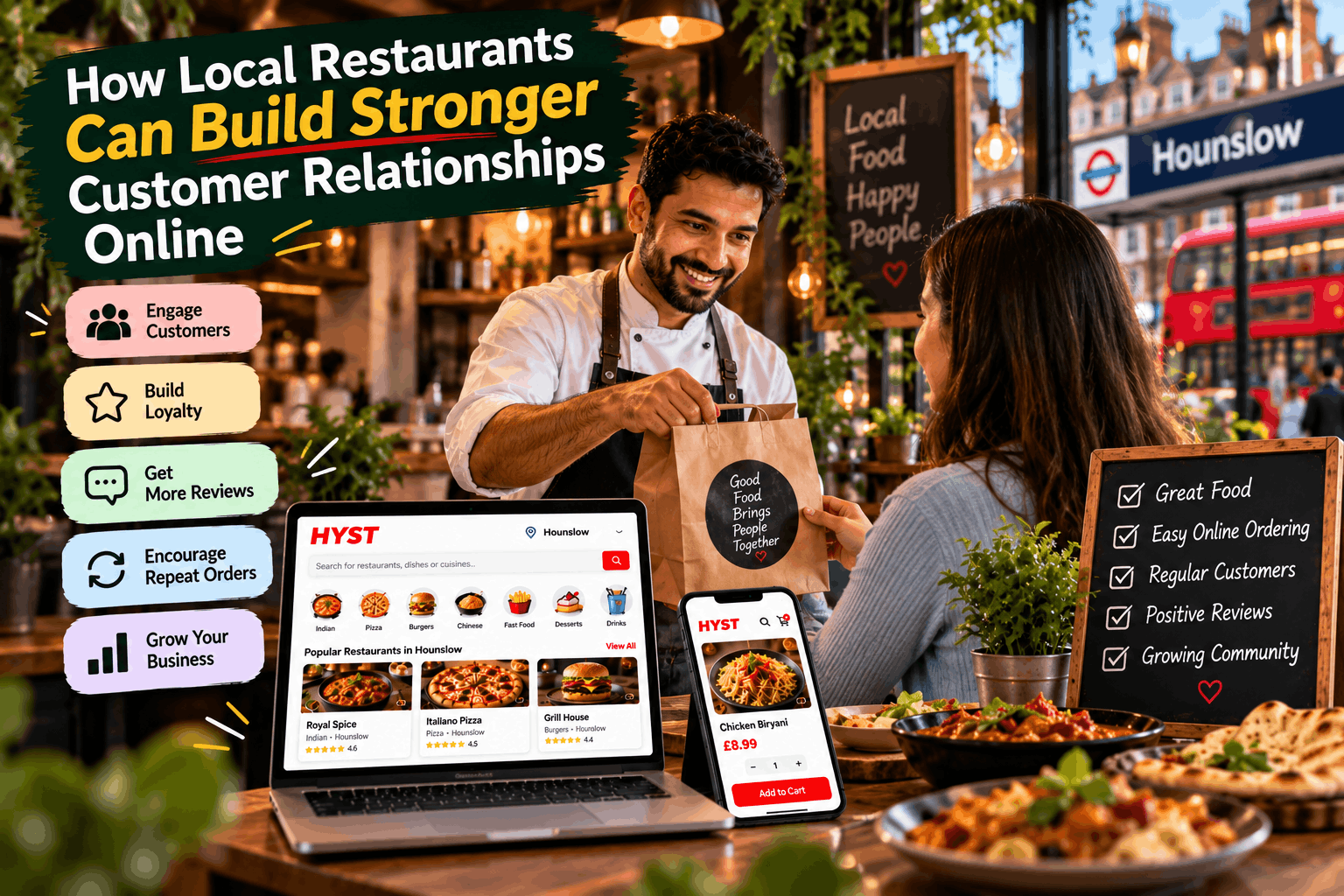
For independent restaurants, cafés, takeaways and food businesses, building strong customer relationships online has become just as important as serving great food in the restaurant itself. Customers now discover local restaurants through search engines, social media, online menus and food ordering platforms before deciding where to eat. Platforms such as HYST can give local restaurants another digital route to showcase their menus and connect with customers looking for convenient online food ordering.
A restaurant's online presence is no longer simply a digital version of its physical shop. It can become a complete customer journey — from discovering a restaurant and browsing the menu to placing an online food order, receiving the food and eventually becoming a repeat customer.
For independent restaurants in Hounslow, London and across the UK, this creates an important opportunity. Instead of focusing only on getting one online order, restaurants can focus on creating an online experience that encourages customers to return.
Why Customer Relationships Matter for Local Restaurants
Restaurant success is not only about attracting new customers.
A new customer may place one order today, but a satisfied customer who returns every week or month can become much more valuable over time. This is why customer loyalty, repeat orders, customer experience and brand recognition are important parts of restaurant marketing.
Local restaurants have an advantage that large food brands cannot easily replicate: they can build a strong local identity.
A family-run Indian restaurant in Hounslow, a local pizza restaurant, a neighbourhood café, a specialist takeaway or a dessert business can create a recognisable personality around its food, service and community.
Online channels can strengthen that relationship.
A customer may first discover a restaurant by searching for:
- restaurants near me
- restaurants in Hounslow
- Hounslow restaurants
- food delivery Hounslow
- takeaway Hounslow
- Indian restaurants Hounslow
- Indian takeaway Hounslow
- pizza delivery Hounslow
- restaurants in London
- food delivery near me
- order food online
- local takeaway near me
- best restaurants near me
- online restaurant ordering UK
The important step is turning that discovery into a positive customer experience.
1. Make Your Restaurant Easy to Discover Online
The first step in building an online customer relationship is visibility.
Customers cannot build a relationship with a restaurant they cannot find.
This is where local SEO for restaurants becomes important. Restaurant owners should make sure their business information is available across relevant online channels and that customers can easily find the restaurant's website, menu and ordering options.
A restaurant targeting Hounslow customers, for example, can naturally create content around relevant searches such as:
Hounslow restaurants, restaurants in Hounslow, Hounslow food delivery, Hounslow takeaway, food delivery Hounslow, Indian food Hounslow, pizza delivery Hounslow, restaurants near me and order food online in Hounslow.
These keywords should not simply be repeated across a page. They should be incorporated naturally into useful content, restaurant descriptions, menu pages, blog articles and local business information.
The objective is simple:
Search → Discover → Explore → Order
A strong digital presence helps reduce the distance between a potential customer discovering a restaurant and becoming an actual customer.
2. Create a Strong Online Restaurant Identity
Your restaurant should look and feel like the same business online as it does offline.
Brand consistency matters.
Customers should be able to recognise your restaurant through:
- Restaurant name
- Logo
- Food photography
- Colours
- Menu design
- Restaurant description
- Tone of communication
- Social media content
- Website
- Online ordering page
If a restaurant has a premium physical environment but an outdated online menu with poor images and incomplete descriptions, the digital experience may not match the customer's expectations.
The same applies to independent takeaways.
A professional digital restaurant presence can help communicate quality before the customer even places an order.
3. Make Your Online Menu Part of the Customer Experience
Your online menu is one of the most important parts of your digital restaurant presence.
Customers want to understand what they are ordering before they pay.
A good digital menu should make it easy to:
- Browse food categories
- View dishes
- See prices
- Read descriptions
- Understand portion options
- Select add-ons
- Identify unavailable items
- Check dietary information
- Understand allergens
- Add items to the basket
- Complete an order
An inaccurate menu can damage trust.
For example, if a customer orders an item that is unavailable, sees an outdated price or discovers that an advertised option is no longer offered, the customer experience can quickly become frustrating.
Restaurant owners therefore need practical online menu management and digital menu management.
According to HYST's current FAQ information, participating restaurants can manage their own menu items, pricing and availability and update them when needed.
4. Keep Restaurant Prices Clear and Accurate
Price transparency is another important part of building trust online.
Customers comparing local restaurants want to understand how much their meal will cost.
Clear restaurant menu pricing can reduce confusion and help customers make decisions more confidently.
Restaurant owners should regularly check:
- Food prices
- Add-on prices
- Meal deals
- Variants
- Availability
- Opening hours
- Delivery information
- Collection information
- Menu descriptions
Even a small pricing error can create an unnecessary customer-service issue.
For businesses targeting searches such as restaurants near me, food delivery near me, Hounslow takeaway or order food online, accurate information can make the ordering journey easier.
For more information about the importance of transparent online pricing, restaurants can also read HYST's guide to clear menu pricing.
5. Make Mobile Ordering Simple
A large part of modern restaurant discovery happens on smartphones.
Customers may search for a restaurant while travelling, during a lunch break, after work or while sitting at home.
That means mobile restaurant ordering needs to be simple.
Customers should not have to:
- Zoom in to read a menu
- Search through multiple pages
- Wait for large images to load
- Click through unnecessary screens
- Repeat information
- Struggle to find the checkout button
A simple mobile ordering journey can make a significant difference.
The ideal experience should be:
Find restaurant → View menu → Select food → Add to basket → Pay → Track order
The fewer unnecessary obstacles customers face, the easier it becomes to convert website visitors into paying customers.
6. Build Trust Through Accurate Food Information
Online customers cannot physically see or smell the food before ordering.
This means restaurant information becomes extremely important.
Good food descriptions can help customers understand:
- What the dish contains
- Main ingredients
- Portion size
- Spice level
- Available options
- Add-ons
- Dietary information
- Allergen information
High-quality food photography can also improve the online menu experience.
However, restaurants should make sure images accurately represent what customers can expect.
Trust is built when the online promise matches the real-world experience.
7. Give Customers a Consistent Ordering Experience
Customer relationships become stronger when the restaurant experience feels consistent.
Imagine a customer discovers your restaurant on Google.
They visit your website.
They find your Instagram page.
They view your online menu.
They place an order.
They receive their food.
Every stage should feel connected.
Important information should remain consistent across channels, including:
- Restaurant name
- Location
- Opening hours
- Menu
- Prices
- Contact details
- Ordering information
- Delivery information
A customer should not have to question which information is correct.
Consistency creates confidence.
8. Use Direct Online Ordering to Strengthen the Customer Journey
Direct online ordering can become an important part of a restaurant's long-term digital strategy.
Rather than thinking only about individual transactions, restaurant owners can think about the entire customer relationship.
For example:
Customer discovers restaurant → Customer views menu → Customer orders → Restaurant delivers → Customer enjoys food → Customer remembers restaurant → Customer orders again
That repeat journey is extremely valuable.
HYST currently promotes direct customer relationships as part of its restaurant partner model, alongside menu and price control.
Restaurants can learn more about the broader role of direct ordering in HYST's guide to increasing direct online orders.
9. Make Repeat Ordering Easy
Getting the first order is only one part of restaurant marketing.
The next objective is encouraging the customer to return.
A restaurant can make repeat ordering easier by maintaining:
- An easy-to-find online menu
- Accurate food information
- Consistent prices
- Reliable service
- Simple checkout
- Clear delivery information
- Strong food quality
- Good customer support
- Consistent branding
A customer who already knows the restaurant may need less convincing to order again.
This is why restaurant customer retention can be just as important as customer acquisition.
The restaurant should not constantly think:
“How can I find another customer?”
It should also ask:
“How can I give this customer a reason to come back?”
10. Use Social Media to Start Conversations
Social media is useful for restaurant discovery, but it can also help build relationships.
Restaurants can use Instagram, Facebook, TikTok and other channels to showcase:
- New dishes
- Behind-the-scenes food preparation
- Seasonal menus
- Restaurant stories
- Customer favourites
- Special menu items
- Local community activity
- Staff and chef stories
- Food photography
- Short-form videos
The goal should not always be to make every post a direct sales message.
Some content can simply remind customers why they like the restaurant.
For example, a local Indian restaurant could create content around traditional dishes, ingredients and preparation.
A pizza restaurant could show how its dough is prepared.
A café could showcase its morning menu.
This creates familiarity.
And familiarity can support customer loyalty.
11. Build a Local Restaurant Community
Independent restaurants are part of their local communities.
For a Hounslow restaurant, this can be particularly useful.
Local SEO and local marketing should not be treated only as ways to get clicks.
They can help restaurants become recognised local brands.
Useful local content could include:
- Food guides
- Local cuisine articles
- Restaurant stories
- Community events
- Seasonal food guides
- Hounslow food recommendations
- Local takeaway guides
- Behind-the-scenes restaurant content
Restaurants can naturally target searches such as:
Hounslow restaurants, food in Hounslow, restaurants near Hounslow, Hounslow food delivery, takeaway in Hounslow, local restaurants in Hounslow and best food near me.
The key is creating useful content rather than producing pages that exist only to target keywords.
12. Give Customers a Reason to Choose Your Restaurant
Competition in the UK restaurant industry is strong.
Customers have many choices.
A restaurant therefore needs to communicate what makes it different.
That difference could be:
- Authentic cuisine
- Family recipes
- Fresh ingredients
- Fast preparation
- Local identity
- Unique dishes
- Excellent service
- Convenient online ordering
- Transparent pricing
- Strong customer experience
The restaurant's website and online menu should communicate this clearly.
Customers should understand why they should order from your restaurant instead of simply choosing another nearby option.
13. Understand the Economics Behind Online Orders
Customer relationships matter, but restaurant owners also need to consider the financial side of online ordering.
Every online order can involve costs such as:
- Food ingredients
- Packaging
- Payment processing
- Delivery
- Marketing
- Technology
- Platform fees or commissions
- Customer acquisition
- Staff time
This is why restaurant owners should evaluate the economics of different online ordering channels.
HYST currently promotes a zero-commission model for participating restaurant partners, while its terms state that specific commercial terms are set out in each restaurant partner's individual agreement.
Restaurants considering different ordering models should always review the applicable commercial terms before making business decisions.
For additional context, restaurants can read HYST's article about zero-commission food ordering.
14. Maintain Control Over the Digital Customer Experience
Independent restaurants often need flexibility.
A restaurant may need to:
- Add a new dish
- Remove a sold-out item
- Change a price
- Update opening hours
- Add an option
- Change an image
- Update descriptions
- Modify availability
Digital restaurant technology should make these tasks easier rather than creating additional work.
HYST's current partner information highlights menu, pricing, variants, add-ons, offers and opening-hours control for participating restaurant partners.
This type of flexibility can be valuable when restaurants operate in a fast-changing environment.
For a deeper discussion of digital control, restaurant owners can read HYST's article on independent restaurants and online ordering control.
15. Turn Good Service Into Repeat Business
Technology can help customers place orders, but technology alone does not create loyalty.
The actual restaurant experience still matters.
A customer is more likely to return when the restaurant consistently provides:
Good food + accurate information + reliable service + simple ordering + clear communication
This is where online and offline experiences come together.
If the online menu says a dish is available, the restaurant should ideally be prepared to provide it.
If the customer receives the food on time and the meal meets expectations, the digital relationship becomes stronger.
Over time, this can create repeat customers and word-of-mouth recommendations.
16. Use Customer Feedback to Improve
Customer feedback can provide valuable insights.
Restaurants can pay attention to recurring comments about:
- Menu clarity
- Food quality
- Packaging
- Delivery
- Portion sizes
- Ordering process
- Pricing
- Customer service
Not every review will be positive, but patterns can reveal areas that need improvement.
For example, if multiple customers struggle to understand a menu category, the restaurant could simplify the menu structure.
If customers repeatedly ask about allergens, more visible allergen information may help.
If customers frequently ask about opening hours, that information should be easier to find.
Listening to customers is one of the simplest ways to improve the online restaurant experience.
17. Use Online Ordering Data Responsibly
Digital ordering can also help restaurants understand customer behaviour.
Depending on the tools and data available to the restaurant, useful business information may include:
- Popular menu items
- Popular categories
- Peak ordering periods
- Average order value
- Popular add-ons
- Repeat ordering patterns
- Seasonal demand
- Delivery demand
This information can support better restaurant decisions.
For example, if a particular dish consistently performs well on Friday evenings, the restaurant can consider preparation, stock and staffing requirements around that demand.
Data should support decision-making rather than replace the restaurant owner's understanding of their customers.
18. Make the Checkout Experience Transparent
Customers want confidence before they complete payment.
The final checkout should make it clear what the customer is paying for.
Important information may include:
- Food subtotal
- Delivery charges where applicable
- Other applicable charges
- Final total
- Delivery or collection method
- Estimated delivery information
- Payment method
Unexpected information appearing late in the ordering process can create hesitation.
A transparent checkout therefore supports trust.
HYST states that online payments on its platform are processed through Worldpay with end-to-end encryption and PCI DSS compliance.
19. Make Your Restaurant Brand Memorable
A customer may see dozens of restaurant posts and menus in a single week.
To stand out, a local restaurant needs a memorable identity.
This can come from:
- A recognisable logo
- Consistent photography
- Signature dishes
- Unique descriptions
- Restaurant storytelling
- Consistent social media content
- A distinctive menu
- Great customer service
The strongest restaurant brands are not remembered only because they sell food.
They are remembered because customers associate them with a particular experience.
20. Think Beyond the First Online Order
The biggest mistake restaurants can make is treating every online order as an isolated transaction.
Instead, think about the customer's entire journey.
Stage 1: Discovery
The customer searches:
“restaurants near me”
Stage 2: Evaluation
They compare:
- Menu
- Food photos
- Prices
- Reviews
- Location
- Delivery options
Stage 3: Ordering
They choose the restaurant and place an online order.
Stage 4: Experience
The restaurant prepares and delivers the food.
Stage 5: Retention
The customer remembers the restaurant and orders again.
Stage 6: Advocacy
A satisfied customer recommends the restaurant to friends or shares it online.
That is how a single online order can potentially develop into a long-term customer relationship.
How HYST Fits Into the Online Restaurant Customer Journey
For independent UK restaurants exploring digital ordering, HYST is one example of a platform designed to connect customers with local restaurant partners.
HYST currently describes its model around direct ordering, genuine restaurant menu pricing, restaurant menu and price control, and a zero-commission approach for participating restaurant partners.
Restaurants should still evaluate any platform based on their own cuisine, customer base, delivery requirements, order volume, technology needs and commercial priorities.
The broader lesson is that restaurant technology should support the restaurant's relationship with its customers rather than making the customer journey more complicated.
Final Thoughts: Stronger Online Relationships Start With Better Experiences
Building stronger customer relationships online does not require a restaurant to use every digital marketing tool available.
It starts with the basics.
A restaurant needs to be easy to discover.
Its online menu needs to be accurate.
Its prices need to be clear.
Its ordering experience needs to work well on mobile.
Its food information needs to build confidence.
Its brand needs to remain consistent.
And most importantly, the restaurant needs to deliver an experience that gives customers a reason to return.
For independent restaurants in Hounslow and across the UK, online food ordering can become more than a way to process transactions. It can become part of a long-term customer relationship strategy.
The most effective customer journey is simple:
Discover → Browse → Trust → Order → Enjoy → Return → Recommend
Restaurants that focus on this complete journey can create a stronger digital presence while continuing to build the local reputation that makes independent food businesses special.
As the UK restaurant industry becomes increasingly digital, customer relationships will remain one of the most valuable assets a local restaurant can build. Technology can provide the tools, but great food, accurate information, reliable service and a consistent customer experience are what turn first-time online visitors into loyal customers.
For restaurants exploring this approach, HYST's restaurant partner programme provides information about its current partner model and onboarding process.
Before making any decision, restaurant owners should review the applicable commercial and platform terms, including HYST's current terms and conditions, and decide whether the model fits their individual business requirements.