Why Local Restaurants Are Looking for Alternatives to High Commission Platforms
For independent restaurants, cafés, takeaways and food businesses across the UK, online ordering has become an important part of attracting customers. People increasingly search for restaurants near me, local restaurants, food delivery, takeaway near me, online food ordering and specific cuisines before deciding where to eat.
For restaurants looking for a different approach to digital ordering, an online food ordering platform for UK restaurants can provide another route for reaching customers while keeping the ordering experience simple and practical.
The growth of online food delivery has created opportunities for independent restaurants, but it has also created an important business question: how much of each online order does the restaurant actually retain?
This is why more restaurant owners are looking at alternatives to traditional high-commission food delivery platforms.
Why High Commission Food Platforms Are a Concern for Independent Restaurants
Large food delivery marketplaces can help restaurants gain visibility and reach customers who may not otherwise discover them. However, restaurant owners also need to look beyond the number of orders generated.
The real business question is the cost of acquiring and fulfilling each order.
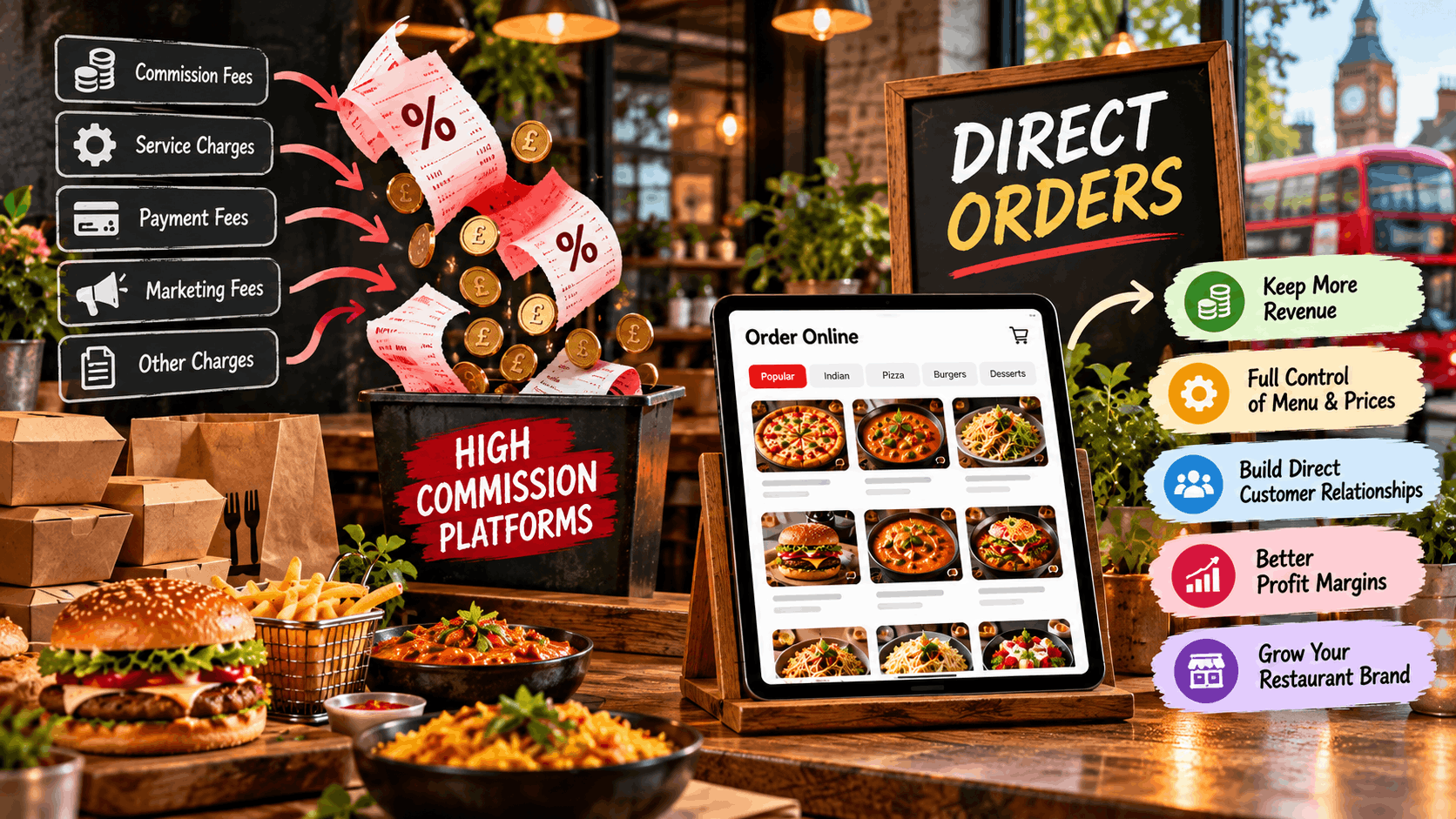
Depending on the platform and agreement, an online restaurant order may involve several costs, including:
- Marketplace commission
- Payment processing
- Delivery charges
- Packaging
- Promotional activity
- Advertising
- Discounts or offers
- Customer acquisition costs
- Other applicable platform fees
For a large restaurant group, these costs may be easier to absorb. For a small independent restaurant, café, takeaway or family-run food business, even a relatively small reduction in retained revenue can have a meaningful impact on margins.
This is why restaurant commission fees, food delivery platform costs, restaurant profit margins and direct online ordering have become important topics for independent businesses.
The Difference Between More Orders and More Valuable Orders
Getting more online orders is obviously important, but order volume should not be the only metric a restaurant considers.
Imagine two restaurants each receiving 100 online orders.
Restaurant A receives the orders through a high-cost marketplace and pays applicable commissions and other expenses.
Restaurant B uses a different ordering model with lower applicable platform costs.
Both restaurants may have generated the same number of orders, but the amount each business retains could be different.
For this reason, restaurant owners should look at:
Total online sales → applicable platform costs → payment costs → delivery costs → packaging → retained revenue
The objective is not simply to find the platform that produces the largest number of orders.
The objective is to find an online ordering strategy that balances customer reach, restaurant visibility, ordering convenience and sustainable restaurant economics.
What Is Zero-Commission Food Ordering?
One alternative receiving attention is zero-commission food ordering.
The basic idea is simple: participating restaurants use an ordering model where a percentage-based marketplace commission is not charged under the applicable commercial model.
HYST currently promotes a zero-commission model for participating restaurant partners, alongside restaurant menu and price control. Restaurants should always check the commercial terms that apply to their individual agreement.
Restaurants interested in understanding the concept can also explore this zero-commission food ordering approach and compare how different online ordering models may work for their business.
The important point is that zero commission does not automatically mean zero costs. Restaurants should still consider payment processing, delivery, packaging, technology and any other applicable charges.
A responsible comparison should always look at the complete commercial picture.
Why Restaurant Owners Want More Control
Another reason independent restaurants are exploring alternatives is control.
Traditional marketplace platforms may become an important source of customers, but restaurants still need to manage their own business information.
An online restaurant menu can change frequently.
A restaurant might:
- Add a new dish
- Change a food price
- Remove a seasonal item
- Mark a product unavailable
- Add an extra topping
- Change opening hours
- Update food descriptions
- Add new photographs
- Change delivery or collection information
If restaurant owners cannot easily update these details, customers may see outdated information.
HYST's current FAQ states that participating restaurants can manage their menu items, pricing and availability.
This type of flexibility is particularly relevant for independent restaurants, local takeaways and small food businesses that need to respond quickly to day-to-day changes.
Restaurant owners can learn more about restaurant menu and price control when comparing online food ordering options.
Clear Restaurant Pricing Matters
Customers are increasingly able to compare restaurants online.
Someone searching for an Indian restaurant in Hounslow might compare several menus.
A customer searching for:
- Indian takeaway Hounslow
- Pizza delivery Hounslow
- Cheap restaurants Hounslow
- Food delivery Hounslow
- Restaurants near Hounslow
- Local takeaway Hounslow
- Online food ordering Hounslow
may look at several restaurants before placing an order.
Price transparency therefore matters.
Customers want to understand what they are ordering and how much it will cost.
For restaurants, maintaining accurate online menu prices can reduce confusion and create a more professional digital experience.
The current HYST platform information states that restaurants manage their own menus and prices, while the platform displays restaurant menu pricing.
Online Menus Are Part of the Customer Experience
A restaurant's digital menu is often the first detailed interaction a customer has with the business.
Before visiting or ordering, customers may want to know:
- What food is available?
- How much does it cost?
- What are the portion options?
- Are there vegetarian choices?
- Are there add-ons?
- Is collection available?
- Is delivery available?
- What are the restaurant's opening hours?
- How quickly can an order be placed?
A complicated or outdated menu can create unnecessary friction.
A good digital restaurant menu should be clear, mobile-friendly and easy to navigate.
The same principle applies whether a customer is ordering Indian food, pizza, burgers, kebabs, Chinese food, desserts or another cuisine.
Mobile Ordering Is Becoming More Important
Many restaurant searches begin on smartphones.
A customer may search Google for food near me, open a restaurant listing, look at the menu and immediately decide whether to order.
That means restaurants need to consider the complete mobile journey.
A simple online ordering process should allow customers to:
- Find the restaurant
- Browse the menu
- Select dishes
- Choose options or add-ons
- Review the basket
- Understand applicable charges
- Complete payment
- Receive order confirmation
Every unnecessary step can create friction.
This is why mobile food ordering, direct restaurant ordering and easy online takeaway ordering are becoming increasingly important for independent food businesses.
Direct Online Ordering Can Give Restaurants Another Option
Direct ordering does not necessarily mean abandoning every third-party marketplace.
Restaurants can use different channels for different purposes.
A marketplace can provide discovery.
A restaurant website can provide brand information.
Social media can create engagement.
A direct ordering platform can provide another route for customers to place an order.
For restaurants interested in developing this type of strategy, the HYST direct online ordering service provides an example of how local restaurants can use online ordering to connect customers with their menus.
The important principle is diversification.
A restaurant does not necessarily have to depend on a single customer acquisition channel.
Building a Stronger Digital Restaurant Presence
Modern restaurant marketing is no longer limited to a printed menu, shop sign or leaflet.
Customers may discover a restaurant through:
- Google Search
- Google Maps
- TikTok
- Restaurant websites
- Food ordering platforms
- Local directories
- Online reviews
- Word of mouth
This creates an opportunity for independent restaurants to build a stronger digital presence.
A restaurant with accurate business information, professional food photography, a clear menu, useful descriptions and a simple ordering option can make it easier for customers to move from search → discovery → menu → order.
This is particularly important for local SEO.
Local SEO and Restaurant Discovery
Local search can be extremely valuable for restaurants.
People do not always search for a restaurant by its exact name.
They may search for:
restaurants near me
restaurants in Hounslow
Hounslow restaurants
food delivery Hounslow
takeaway near me
Indian restaurants Hounslow
pizza delivery Hounslow
best takeaway Hounslow
online food ordering Hounslow
These searches demonstrate strong local intent.
Restaurants should therefore make sure their online information clearly communicates their location, cuisine, opening hours, menu and ordering options.
Platforms that help customers discover local restaurants can also become part of that wider digital journey.
Why Independent Restaurants Are Looking Beyond Commission Alone
The conversation around online ordering is becoming broader.
Restaurant owners are not simply asking:
“Which platform can bring me the most orders?”
They are increasingly asking:
“Which ordering model makes the most sense for my business?”
That means considering:
- Commission structure
- Payment processing
- Delivery arrangements
- Menu control
- Pricing control
- Customer experience
- Brand visibility
- Customer relationships
- Order management
- Mobile usability
- Support
- Reporting
- Overall retained revenue
A platform that looks attractive because it generates many orders may not necessarily be the most suitable option for every restaurant.
Likewise, a lower-cost model is only useful if customers can actually find the restaurant and complete their orders easily.
The strongest approach is therefore a balanced one.
Customer Experience Still Comes First
Restaurant economics are important, but customers remain at the centre of online ordering.
A customer does not care about the restaurant's commission structure if they cannot find the menu.
They do not care about sophisticated technology if checkout does not work.
They do not care about a restaurant's digital strategy if prices are unclear.
A successful online food ordering experience needs to combine business efficiency with customer convenience.
That means:
- Fast menu browsing
- Clear prices
- Accurate availability
- Easy navigation
- Simple checkout
- Secure payment
- Reliable order updates
- Convenient delivery or collection
The technology should make ordering easier rather than making the process more complicated.
HYST and the Alternative Ordering Conversation
For restaurants exploring alternatives to high-commission marketplace models, HYST is one platform currently operating in the UK restaurant ordering space.
HYST describes itself as a food ordering marketplace connecting customers with independent restaurant partners. Its current public information highlights restaurant discovery, direct ordering, menu and price control and a zero-commission model for participating restaurant partners. Specific commercial terms are governed by the individual restaurant agreement.
Restaurants can also review the HYST restaurant partner programme to understand the current onboarding and partner proposition.
For customers, HYST focuses on discovering local restaurants, browsing menus and ordering online.
For restaurant owners, the proposition centres around having another digital ordering channel while retaining control over important restaurant information.
Restaurants Should Compare Platforms Carefully
There is no universal solution for every restaurant.
A small café may have completely different requirements from a busy takeaway.
Before choosing an online ordering platform, restaurant owners should ask:
1. What are the applicable costs?
Look beyond the headline commission and understand the complete cost structure.
2. Can I control my menu?
Restaurants need the ability to keep food information accurate.
3. Can I update prices?
Menu pricing should be manageable when business costs change.
4. Can I control availability?
Restaurants should be able to prevent customers from ordering unavailable dishes.
5. Is the ordering experience mobile-friendly?
Most customers expect a straightforward smartphone experience.
6. How does delivery work?
Restaurants should understand who handles delivery and what charges apply.
7. How are payments processed?
Payment security and reliability are important parts of customer trust.
8. Can the platform help customers discover my restaurant?
Visibility matters because even the best ordering system needs customers.
9. What happens to my customer journey?
Restaurants should consider how the ordering platform fits into their wider brand and customer experience.
The Future of Online Food Ordering for Independent Restaurants
The UK restaurant industry is becoming increasingly digital.
Customers are comfortable discovering restaurants online, checking menus from their phones and placing food orders without calling the restaurant.
At the same time, restaurant owners are becoming more aware of the economics behind online sales.
This means the future of restaurant technology is unlikely to be based only on generating more orders.
The bigger question will be how restaurants can create profitable online orders, stronger customer experiences and sustainable digital channels.
Independent restaurants may increasingly look for solutions that combine:
Local restaurant discovery + direct online ordering + menu control + price transparency + customer convenience + sustainable restaurant economics.
This shift could be particularly relevant in competitive local markets such as Hounslow, where customers can compare restaurants, cuisines and prices online within minutes.
Final Thoughts
High-commission food delivery platforms have helped independent restaurants reach online customers, but restaurant owners are now looking more carefully at the economics behind those orders.
The discussion is moving beyond simply asking how many orders a platform can generate.
Restaurant owners also want to understand:
- How much revenue they retain
- How much control they have
- How easily they can update menus
- How prices are displayed
- How customers discover their business
- How simple the ordering journey is
- How delivery works
- How the platform supports long-term digital growth
For independent restaurants, cafés and takeaways, exploring alternatives to high-commission platforms can therefore be a sensible part of a broader digital strategy.
Restaurants considering different online ordering options can review the HYST restaurant ordering platform and compare its current features, partner information and applicable commercial terms before deciding whether it fits their business.
The goal should not simply be more online orders.
The goal should be better online ordering for restaurants and customers alike.