Online Food Ordering: What Independent Restaurants Should Know
For independent restaurants, online food ordering is no longer simply a technical extra. It has become an important part of how customers discover restaurants, browse menus, compare prices and decide what they want to eat. Whether it is a family-run takeaway, local café, Indian restaurant, pizza shop or larger restaurant group, having a reliable online restaurant ordering system can create another important connection between a business and its customers.
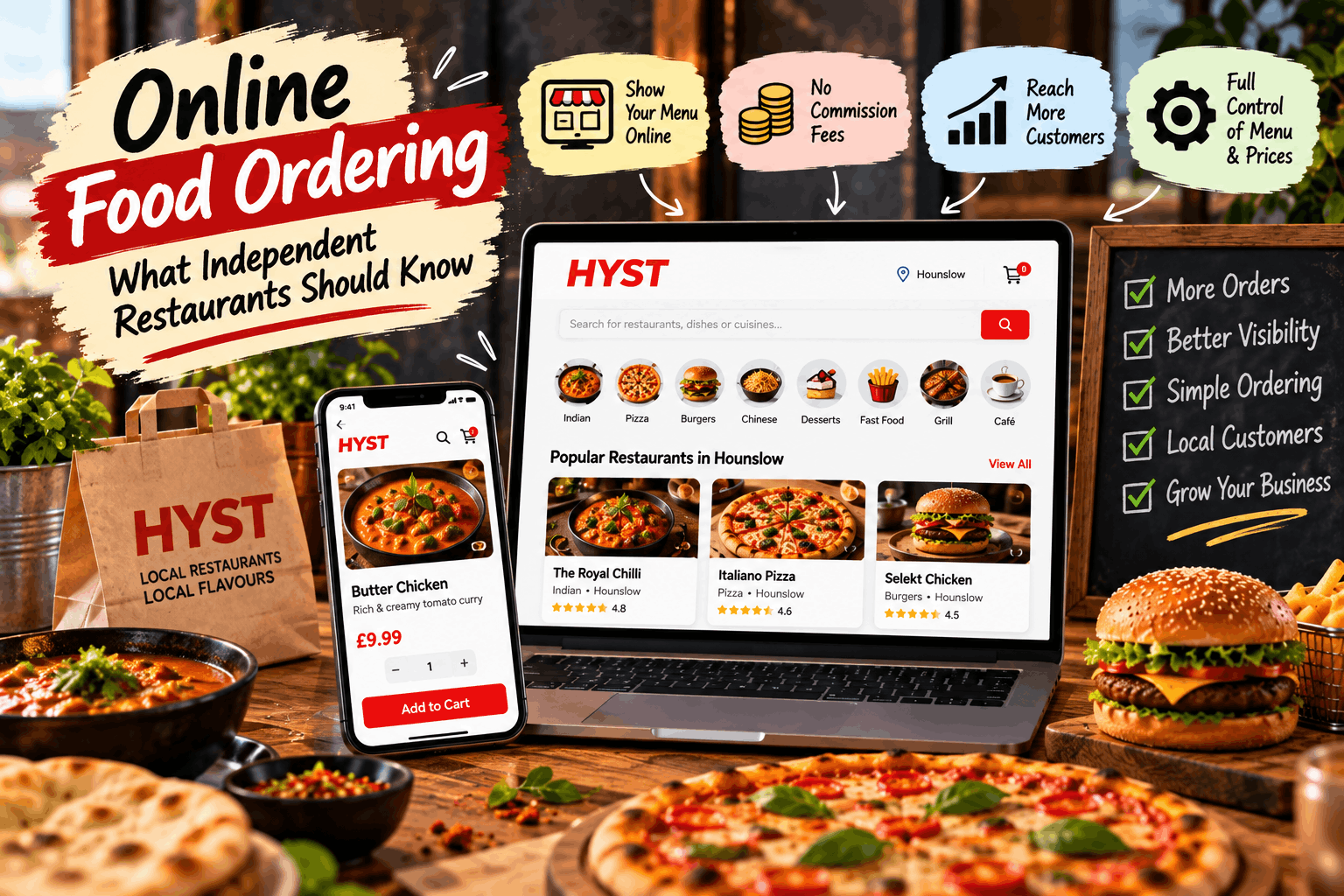
For restaurants exploring different digital ordering options, HYST is one platform currently focused on restaurant discovery and direct online food ordering. HYST's current information highlights restaurant menu and price control and a zero-commission model for participating restaurant partners.
Why Online Food Ordering Matters for Independent Restaurants
The way customers choose restaurants has changed significantly.
A customer may previously have walked past a restaurant, seen an advertisement or asked a friend for a recommendation. Today, the journey can start with a smartphone search.
Customers may search for:
- Restaurants near me
- Food delivery near me
- Takeaway near me
- Restaurants in Hounslow
- Hounslow food delivery
- Order food online
- Indian restaurants near me
- Pizza delivery near me
- Best takeaway near me
- Local restaurants
- Online restaurant ordering
- Direct food ordering
Once a customer discovers a restaurant, they can immediately compare menus, prices, reviews and ordering options.
This means online restaurant visibility is becoming increasingly important for independent food businesses.
What Should Restaurants Look for in an Online Ordering Platform?
Choosing an online ordering platform for restaurants should not be based on one feature alone.
Restaurant owners should consider the complete system.
Important questions include:
- How easy is it for customers to order?
- Can the restaurant control its menu?
- Can prices be changed easily?
- Can unavailable products be removed?
- What commission or service fees apply?
- How are payments processed?
- How does delivery work?
- What customer support is available?
- Can the restaurant manage orders in real time?
- Does the platform work well on mobile devices?
These questions can help an independent restaurant compare different food ordering platforms before making a decision.
The Customer Experience Comes First
An online ordering platform should make ordering food easier, not harder.
Customers usually want to complete the process quickly.
They should be able to:
Find a restaurant → Browse the menu → Select food → Review the order → Pay → Track the order
If the menu is confusing or the checkout process takes too many steps, customers may abandon the order.
This is why restaurant user experience, mobile food ordering, online menu design and simple checkout are important parts of a successful digital ordering strategy.
A Mobile-Friendly Menu Is Essential
Many customers discover and order food using smartphones.
A restaurant's online menu should therefore be easy to use on a small screen.
Customers should be able to clearly see:
- Food names
- Food descriptions
- Prices
- Food categories
- Add-ons
- Options
- Availability
- Delivery information
A menu that looks good on a desktop but is difficult to navigate on a mobile phone can still create a poor customer experience.
For independent restaurants, a mobile-friendly online menu should be considered an essential part of digital ordering.
Menu and Price Control
Restaurant menus change regularly.
A restaurant may introduce a new dish, change a price, remove an unavailable product or update its opening hours.
For this reason, restaurant owners need control over their digital menu.
HYST's current FAQ states that restaurants can manage their own menu items, pricing and availability and update them when required.
This can be particularly useful for independent businesses where menu changes happen frequently.
Restaurant owners should be able to keep their online information aligned with their actual business.
Clear Pricing Builds Customer Confidence
Price transparency is another important part of online food ordering.
Customers want to know what they are paying for before completing an order.
For example, if a customer selects a main meal, side dish and drink, the pricing for each item should be easy to understand.
Clear pricing can help reduce confusion around:
- Menu prices
- Add-ons
- Delivery charges
- Applicable fees
- Final order total
HYST currently states that restaurants manage their own prices and that the platform displays their genuine menu pricing without additional markups.
For customers, transparent menu information can make restaurant comparison easier.
Understanding Restaurant Commission Fees
One of the biggest considerations for independent restaurants is the cost of receiving online orders.
Restaurant owners may need to consider:
Food cost + packaging + payment processing + delivery + platform charges = total order cost
Marketplace commission can also affect the amount of revenue a restaurant keeps from an order.
This is why terms such as:
- Restaurant commission fees
- Food delivery commissions
- Online ordering costs
- Restaurant profit margins
- Zero commission food ordering
- Direct restaurant ordering
are increasingly relevant when restaurants evaluate digital ordering.
Getting more orders is valuable, but restaurants also need to understand how much value they retain from those orders.
What Does Zero-Commission Food Ordering Mean?
Zero-commission food ordering is an ordering model where participating restaurants do not pay a percentage-based marketplace commission under the applicable commercial arrangement.
HYST currently promotes a zero-commission model for participating Restaurant Partners. Its terms also state that HYST operates a “zero commission” or low-commission model for participating Restaurant Partners, with specific commercial terms set out in each restaurant's vendor agreement.
This distinction is important.
Zero commission does not automatically mean that every possible cost connected to an online order disappears.
Restaurants should still understand payment processing, delivery arrangements, service charges and any other applicable costs.
Why Independent Restaurants May Consider Direct Ordering
Independent restaurants often want to build a strong relationship with their customers.
Direct online ordering can become one part of that strategy.
Instead of depending entirely on one third-party channel, restaurants can create several digital routes through which customers can discover the business.
These can include:
- Restaurant website
- Google Business Profile
- Social media
- Online menu
- Restaurant ordering platforms
- QR codes
- Local SEO
- Customer reviews
The objective is to make it easy for customers to move from discovering a restaurant to actually placing an order.
Restaurant Profit Margins Matter
Online sales should be evaluated from a business perspective.
A restaurant might receive more orders through an online channel but still need to carefully evaluate its profitability.
For example, restaurant owners can calculate:
Total order value − food cost − packaging − payment costs − delivery costs − applicable platform costs
This can provide a clearer picture of the contribution from an online order.
Understanding restaurant profit margins helps owners compare different ordering channels based on actual business performance rather than simply order volume.
Delivery Is Another Important Consideration
Food ordering and food delivery are closely connected, but they are not exactly the same thing.
Restaurant owners need to understand how delivery is handled.
Questions can include:
- Does the restaurant use its own drivers?
- Is a third-party courier involved?
- What is the delivery area?
- What delivery charges apply?
- How are delivery problems handled?
- Can customers track their orders?
HYST currently says its doorstep deliveries are powered by Uber Direct and that customers can track orders in real time.
The delivery model should always be evaluated alongside the ordering platform's other commercial and operational terms.
Restaurant Order Management Should Be Simple
Independent restaurants already have many daily responsibilities.
Staff need to prepare food, serve customers, manage stock, clean the restaurant and handle takeaway orders.
An online ordering system should therefore make order management straightforward.
HYST states that orders come through in real time to the restaurant dashboard, where restaurant partners can accept, prepare and update order status.
A practical restaurant order management system can help staff understand incoming orders and reduce unnecessary confusion during busy periods.
Keeping Online Menus Accurate
An online menu should reflect what the restaurant actually sells.
Restaurant owners should regularly check:
- Menu items
- Prices
- Descriptions
- Availability
- Opening hours
- Delivery areas
- Collection options
- Add-ons
- Allergen information
HYST's terms state that restaurant partners are responsible for the accuracy of their menu, pricing, photos, descriptions, allergen information and opening hours displayed on the platform.
Keeping this information accurate is important for both customer trust and restaurant operations.
Local SEO Can Help Restaurants Get Found
For independent restaurants, local restaurant SEO can help increase online visibility.
A restaurant in Hounslow, for example, may want to appear for searches such as:
Hounslow restaurants
restaurants in Hounslow
Hounslow food delivery
Hounslow takeaway
Indian restaurant Hounslow
best restaurants Hounslow
food delivery near me
takeaway near me
order food online Hounslow
However, restaurants should not simply repeat these keywords excessively.
Good SEO comes from useful information, accurate business details, relevant content, strong local signals and a positive customer experience.
Online Ordering and Social Media Can Work Together
Social media can help restaurants create awareness, while online ordering can make it easier for customers to take action.
For example:
Instagram post → Restaurant profile → Online menu → Order
or:
TikTok food video → Restaurant search → Menu → Order
Restaurants can use social media to promote:
- New dishes
- Popular meals
- Behind-the-scenes content
- Restaurant events
- Seasonal menus
- Food photography
- Customer experiences
The important thing is to give customers a clear next step after they discover the restaurant.
Online Ordering Can Support Customer Relationships
Independent restaurants often compete through their personality and local identity.
Customers may return because they enjoy the food, know the staff or like the atmosphere.
The digital experience should support that relationship rather than make the restaurant feel invisible behind technology.
HYST's current partner information highlights direct customer relationships as part of its restaurant proposition.
For restaurant owners, the long-term objective should be to create customers who return—not simply one-time transactions.
Restaurants Should Compare Different Ordering Models
There is no single ordering system that is perfect for every restaurant.
A family-run takeaway may have different requirements from a café or a multi-location restaurant group.
Before choosing an online restaurant ordering platform, owners should compare:
Commission structure
Understand what percentage-based commissions or other applicable charges exist.
Menu control
Check how easily the restaurant can update products and prices.
Payment processing
Understand how customers pay and how restaurant payouts work.
Delivery
Review the delivery arrangements and associated costs.
Customer support
Find out how order problems are handled.
Customer experience
Test the platform yourself before recommending it to customers.
Reporting
Consider whether the platform provides useful information for managing the business.
Why Direct Revenue Can Matter
For an independent restaurant, the difference between gross order value and the amount retained by the business can be significant.
This is why restaurant owners should understand the economics behind every ordering channel.
HYST's current partner page promotes a 0% commission model, direct revenue and menu/price control for participating restaurant partners.
The exact commercial terms should still be reviewed by each restaurant before entering into an agreement.
Choosing an Online Ordering Platform
Before selecting an online food ordering platform, restaurant owners can create a simple checklist.
Ask:
Is the ordering experience easy for customers?
Is the menu easy to manage?
Can prices be updated quickly?
Are unavailable items easy to remove?
What are the applicable costs?
How does delivery work?
How are payments processed?
What support is available?
Can the restaurant maintain its brand identity?
These questions can help owners make a more informed decision.
The Future of Online Food Ordering
The restaurant industry is becoming increasingly digital.
Customers expect restaurants to be easy to discover online, menus to be available digitally and ordering to be convenient.
At the same time, independent restaurants want:
- Better profit margins
- More control
- More customers
- Easier order management
- Accurate menus
- Transparent pricing
- Reliable delivery
- Stronger customer relationships
This means the future of online food ordering in the UK will likely continue to focus on balancing customer convenience with restaurant economics.
Final Thoughts
Online food ordering can provide independent restaurants with another way to reach customers, display menus and generate sales.
But choosing an ordering platform should be treated as a business decision—not simply a technology decision.
Restaurant owners should look at the complete picture, including commission fees, payment processing, delivery costs, menu control, customer experience, local SEO, order management and restaurant profit margins.
For participating restaurants exploring an alternative ordering model, HYST's restaurant partner page provides information about its current zero-commission partner model and onboarding process.
Ultimately, successful online ordering should benefit both sides.
Customers want a simple, transparent and convenient way to order food.
Independent restaurants want a practical digital channel that helps them reach customers while keeping more value from their online orders.
As online food ordering continues to evolve across the UK, restaurants that understand their customers, costs and digital channels will be better positioned to make informed decisions.