How Restaurants Can Make Online Ordering Easier for Customers
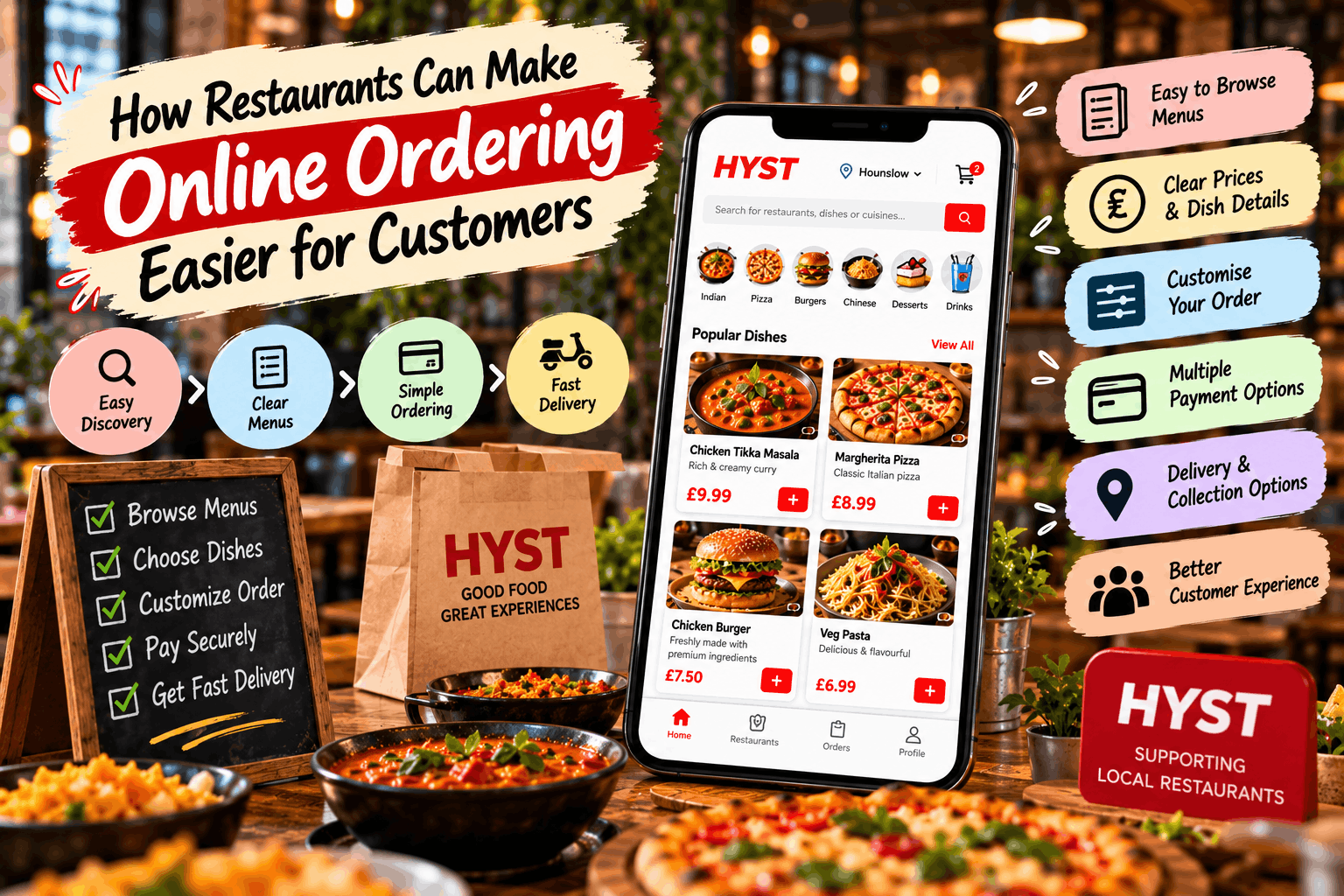
Online food ordering has become an important part of the modern restaurant experience. Customers increasingly expect to discover restaurants online, browse a digital menu, compare prices, customise their meals and place an order from their phone without unnecessary steps. For restaurants looking to improve this journey, using a reliable online food ordering platform for UK restaurants can make it easier to connect customers with menus and ordering options. Explore HYST online food ordering
For independent restaurants, cafés, takeaways and food businesses, making online ordering easier is not simply about adding an "Order Now" button. The complete customer journey matters.
A customer may discover a restaurant through Google, social media, a local search, a restaurant directory or a food ordering platform. They then need to find the menu, understand the prices, select their food, customise the order, choose delivery or collection and complete payment.
If any part of this process is confusing, slow or difficult to use, the customer may abandon the order.
That is why restaurants should focus on creating a simple, fast and mobile-friendly online ordering experience.
Why Online Ordering Experience Matters
Imagine a customer searching for:
- Restaurants near me
- Restaurants in Hounslow
- Hounslow restaurants
- Hounslow takeaway
- Food delivery Hounslow
- Order food online Hounslow
- Indian restaurants Hounslow
- Pizza delivery Hounslow
- Takeaway near Hounslow
- Local restaurants near me
The customer may compare several restaurants before deciding where to order.
At this stage, the restaurant needs to provide useful information quickly.
Customers generally want to know:
- What food is available?
- How much does it cost?
- Are there vegetarian options?
- Can dishes be customised?
- Is delivery available?
- Is collection available?
- How long might delivery take?
- What payment options are available?
- Is the online menu accurate?
A restaurant that answers these questions clearly can create a much smoother digital restaurant ordering experience.
1. Create a Mobile-Friendly Restaurant Ordering Experience
One of the most important things restaurants can do is make online ordering easy on smartphones.
Customers frequently browse restaurants using mobile devices, so the ordering page should be designed around a smaller screen.
A good mobile food ordering experience should have:
- Clear menu categories
- Large readable text
- Easy navigation
- Clear food images
- Visible prices
- Simple add-to-cart buttons
- Easy basket access
- Straightforward checkout
- Clear delivery information
- Secure online payment
Customers should not have to zoom in, scroll sideways or navigate through multiple unnecessary pages just to order a meal.
The fewer unnecessary steps, the easier the ordering process becomes.
2. Keep the Digital Menu Simple
A restaurant menu should help customers make decisions rather than overwhelm them.
An online restaurant menu can contain many categories, but the structure should remain easy to understand.
For example:
Starters
- Samosas
- Spring Rolls
- Chicken Tikka
- Garlic Bread
Main Courses
- Curries
- Grilled Dishes
- Burgers
- Pizza
- Pasta
Sides
- Chips
- Rice
- Naan
- Salads
Desserts
- Cakes
- Ice Cream
- Cheesecake
Drinks
- Soft Drinks
- Juices
- Milkshakes
Clear categories can help customers find what they want faster.
This is particularly useful for Indian restaurants, pizza restaurants, burger restaurants, cafés, takeaways and independent food businesses with large menus.
3. Display Accurate Prices
Price transparency is extremely important in online food ordering.
Customers want to understand what they are paying before they reach checkout.
Restaurants should make sure that their digital menu clearly displays:
- Dish prices
- Size options
- Add-ons
- Variations
- Meal options
- Delivery charges
- Collection information
- Any applicable fees
If the price displayed on the menu is different from the price shown at checkout, customers may become confused or lose trust.
Restaurant owners should therefore regularly review their online menu pricing.
HYST's current FAQ states that restaurants can manage their own menus and prices and that the platform displays their genuine menu pricing without additional menu markups.
4. Make Food Descriptions Clear
Food descriptions are another important part of the online ordering experience.
Simply writing:
Chicken Burger
does not tell the customer very much.
A better description could explain:
- Type of chicken
- Bread or bun
- Sauce
- Salad
- Cheese
- Spices
- Serving style
For example:
Crispy chicken burger served with lettuce, tomato, cheese and house sauce.
Clear descriptions can help customers make faster decisions.
They can also make an online restaurant menu feel more professional.
However, descriptions should always be accurate and should not make claims that the restaurant cannot support.
5. Use High-Quality Food Images
People eat with their eyes first.
High-quality food photography can make an online menu more attractive and help customers understand what a dish looks like.
Restaurants can prioritise images for:
- Best-selling dishes
- Signature meals
- Popular starters
- Burgers
- Pizza
- Curries
- Desserts
- Meal combinations
However, images should accurately represent the food customers are likely to receive.
A strong combination of food photography + clear descriptions + transparent pricing can make menu browsing easier.
6. Make Food Customisation Easy
Many restaurant orders involve customisation.
Customers may want to:
- Remove onions
- Add cheese
- Choose a spice level
- Select a sauce
- Choose a portion size
- Add toppings
- Choose a side
- Select dietary preferences
If customers have to call the restaurant for every small change, the online ordering experience becomes less convenient.
A good restaurant ordering platform should make relevant variations and add-ons easy to understand.
This can be especially useful for restaurants with:
- Pizza toppings
- Burger extras
- Curry spice levels
- Meal upgrades
- Drink choices
- Side options
- Vegetarian alternatives
7. Keep Unavailable Items Updated
One of the most frustrating experiences for customers is ordering something that the restaurant cannot provide.
For example, a restaurant may run out of a popular dish during a busy evening.
If that item remains available online, customers may place an order expecting to receive it.
Restaurants should therefore be able to update food availability quickly.
HYST's current platform information states that restaurant partners can manage menu items, pricing and availability.
This type of control can help restaurants keep their digital menu closer to their real-time operations.
8. Reduce Unnecessary Checkout Steps
A complicated checkout can cause customers to abandon their basket.
The ordering journey should ideally be:
Browse → Select → Customise → Review → Pay → Confirmation
Restaurants should avoid unnecessary forms or confusing navigation.
Before completing an order, customers should be able to see:
- Selected items
- Quantities
- Item prices
- Delivery or collection details
- Applicable charges
- Total order value
- Payment method
Clear information gives customers confidence before they click the final payment button.
9. Make Delivery and Collection Information Clear
Customers need to understand how they will receive their food.
Restaurants should clearly communicate:
- Delivery availability
- Collection availability
- Estimated preparation time
- Delivery area
- Minimum order requirements
- Delivery charges
- Collection instructions
- Order tracking where available
For restaurants offering both food delivery and collection, these options should be easy to find.
A customer should not have to search through several pages to understand whether delivery is available to their postcode.
10. Offer a Reliable Online Payment Experience
Online payment is another important part of restaurant ordering.
Customers expect checkout to be secure, straightforward and easy to understand.
Restaurants should use established payment infrastructure and ensure customers can clearly see the final order amount before payment.
HYST currently states that online payments on its platform are processed through Worldpay and that transactions use encryption and PCI DSS-compliant payment infrastructure.
For restaurant owners, a smooth payment experience can help remove another potential barrier between menu browsing and completed orders.
11. Give Customers a Clear Order Confirmation
After completing an online order, customers want reassurance that the order has gone through.
A useful order confirmation should communicate:
- Order confirmation
- Order number
- Restaurant name
- Ordered items
- Total amount
- Delivery or collection details
- Estimated timing
- Tracking information where available
This can reduce uncertainty and help customers understand what happens next.
HYST's platform information states that orders are received by restaurants in real time through the restaurant dashboard, where orders can be accepted, prepared and updated.
12. Make Direct Online Ordering Easy to Find
Restaurants should not hide their ordering option.
An Order Online button should be easy to find on:
- Restaurant website
- Google Business Profile
- Instagram profile
- Facebook page
- Digital advertisements
- Email campaigns
- QR codes
- Restaurant landing pages
The objective is to reduce the distance between discovering the restaurant and placing an order.
For independent restaurants, a strong direct ordering strategy can help create a more straightforward digital journey. HYST has also published guidance around increasing direct online orders for Hounslow restaurants. HYST guide to direct online orders
13. Optimise Online Ordering for Local SEO
Online ordering and SEO can work together.
Restaurants should create useful online content around the areas and services they actually serve.
Potential search terms include:
- Restaurant in Hounslow
- Restaurants in Hounslow
- Food delivery Hounslow
- Takeaway Hounslow
- Online food ordering Hounslow
- Indian takeaway Hounslow
- Pizza delivery Hounslow
- Burger delivery Hounslow
- Restaurants near Hounslow
- Takeaway near me
- Food delivery near me
- Restaurants near me
However, restaurants should avoid stuffing these keywords into every sentence.
Instead, use them naturally in:
- Page titles
- Headings
- Restaurant descriptions
- Menu pages
- Location pages
- Blog content
- Image alt text
- Meta descriptions
- Internal links
The main objective should always be to create useful content for customers.
14. Keep Restaurant Information Consistent
A restaurant may have information spread across multiple online platforms.
For example:
- Website
- Google Business Profile
- Restaurant directories
- Ordering platforms
- Local business listings
If opening hours, phone numbers, addresses or menu prices are different across these channels, customers can become confused.
Restaurants should regularly check that their important business information remains accurate.
Consistent information can also support a stronger local SEO strategy for restaurants.
15. Give Restaurants More Control Over Their Online Menu
Restaurant businesses change quickly.
A new dish may be introduced.
A price may need updating.
An ingredient may become unavailable.
Opening hours may change.
A restaurant ordering system should make these updates practical.
HYST's restaurant platform information currently highlights control over:
- Menu items
- Prices
- Variants
- Add-ons
- Offers
- Opening hours
- Availability
The platform also states that restaurant partners can update these details through their dashboard. HYST restaurant menu and ordering information
This can be particularly useful for independent restaurants that need to manage their menus regularly.
16. Make the Ordering Experience Match the Restaurant Brand
Online ordering should not feel disconnected from the restaurant.
The restaurant's:
- Logo
- Food photography
- Colours
- Menu style
- Dish descriptions
- Restaurant story
- Cuisine
- Brand personality
can all contribute to the digital experience.
For example, a premium Indian restaurant may want a sophisticated menu presentation, while a casual burger takeaway may prefer a simpler and more energetic ordering experience.
The technology should support the restaurant rather than make every business look identical.
17. Understand the Cost of Online Orders
Restaurants should look beyond order volume.
Getting 100 orders does not automatically mean a restaurant has generated 100 equally valuable sales.
Restaurant owners should understand the costs associated with their online ordering channel, which can include:
- Platform commissions
- Payment processing
- Delivery costs
- Packaging
- Marketing
- Promotions
- Customer acquisition
- Operational costs
For independent restaurants, understanding restaurant profit margins is especially important.
HYST's current terms state that it operates a zero-commission or low-commission model for participating restaurant partners, with specific commercial terms determined by each restaurant's vendor agreement. HYST terms and commercial model
Restaurants should always review the commercial agreement applicable to their own business before making financial assumptions.
18. Build Direct Customer Relationships
Online ordering should not only be about completing a single transaction.
Restaurants want customers to come back.
A good digital experience can help build familiarity with the restaurant.
Customers may remember:
- Their favourite dish
- Their previous order
- The restaurant brand
- The quality of the food
- The convenience of ordering
- The overall experience
Independent restaurants can then focus on providing consistent food quality and a reliable digital ordering journey.
This is one reason greater control over the online ordering experience has become an important discussion for independent restaurants. Why independent restaurants need more online ordering control
19. Make Restaurant Discovery Easier
Customers need to discover the restaurant before they can order from it.
A restaurant can improve discovery through:
- Local SEO
- Google Business Profile optimisation
- Social media
- Restaurant directories
- Local backlinks
- Food blogs
- Online ordering platforms
- Customer reviews
- Location-based content
Hounslow restaurants, for example, can create useful content around local searches such as Hounslow food delivery, restaurants in Hounslow, takeaway Hounslow and online food ordering Hounslow.
Platforms such as HYST can also provide another route for customers to discover local restaurants and browse their menus. HYST local restaurant discovery platform
20. Choose an Online Ordering Platform Carefully
Restaurants should compare online ordering platforms before choosing one.
Important questions include:
- Is the platform mobile-friendly?
- Can restaurants manage their own menus?
- Can prices be updated?
- Can restaurants control availability?
- How are payments processed?
- How does delivery work?
- What fees apply?
- Is customer support available?
- Can customers easily browse the restaurant?
- Is the checkout experience simple?
- Can the restaurant maintain its brand identity?
HYST's current partner information promotes a zero-commission model for participating restaurant partners, direct customer relationships and menu and price control. HYST restaurant partner programme
The right platform will depend on each restaurant's needs, operating model and individual commercial agreement.
A Simple Online Ordering Checklist for Restaurants
Before launching or improving an online ordering system, restaurants can use this checklist:
Menu
✓ Clear categories
✓ Accurate prices
✓ Useful food descriptions
✓ High-quality images
✓ Add-ons and variations
✓ Dietary information where applicable
✓ Available/unavailable items updated
Ordering
✓ Mobile-friendly
✓ Simple navigation
✓ Easy basket management
✓ Clear checkout
✓ Secure payment
✓ Order confirmation
Delivery
✓ Delivery area clearly displayed
✓ Collection option where available
✓ Clear charges
✓ Estimated preparation/delivery information
✓ Tracking where available
SEO
✓ Local keywords
✓ Optimised restaurant pages
✓ Accurate business information
✓ Internal links
✓ Useful local content
✓ Quality backlinks
✓ Mobile-friendly pages
Final Thoughts
Making online ordering easier for customers does not necessarily require complicated technology.
The most important improvements are often simple:
Clear menus.
Accurate prices.
Easy navigation.
Fast mobile ordering.
Simple customisation.
Secure payment.
Clear delivery information.
Reliable order confirmation.
For independent restaurants, cafés and takeaways, these improvements can help create a smoother journey from restaurant discovery to completed order.
As more customers search online for restaurants, menus and food delivery, the quality of the digital ordering experience can become an important part of how a restaurant competes locally.
For Hounslow restaurants and UK independent food businesses, platforms such as HYST provide another route for restaurant discovery and online ordering, while giving participating restaurant partners tools to manage menus, pricing and availability.
Ultimately, the best online ordering experience is one that works for both sides:
Customers get a simple way to discover and order food.
Restaurants get a practical digital channel that is easier to manage and understand.
That combination can help restaurants create better customer experiences, strengthen their digital presence and build a stronger foundation for long-term online growth.