How Restaurants Can Keep More Value From Online Orders
For independent restaurants, online ordering is no longer simply a technical extra. It has become an important part of how customers discover local businesses, browse menus, compare prices and decide where to order food. As more customers search for restaurants near me, takeaway near me, food delivery near me and order food online, restaurant owners are looking for better ways to manage their online ordering costs while still providing a convenient customer experience.
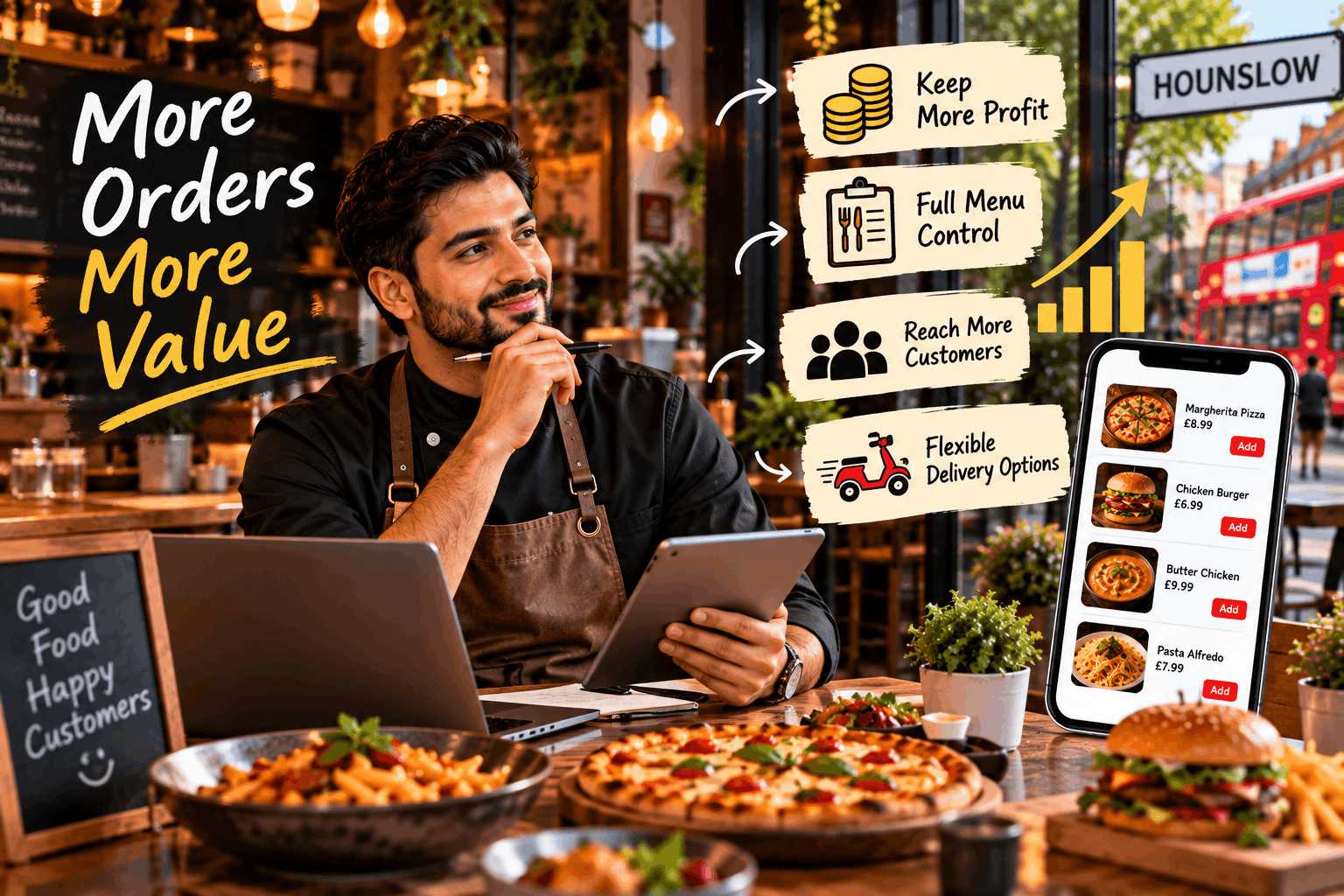
For restaurants exploring different ordering models, HYST provides an option focused on direct food ordering and a zero-commission model for participating restaurant partners. Its current partner information highlights direct revenue, customer relationships and menu and price control.
Why Online Ordering Costs Matter to Restaurants
Every online food order has an impact on a restaurant's overall revenue and profitability.
A restaurant may receive a £30 online order, but the amount it actually retains depends on the costs associated with that order. These can include food ingredients, packaging, payment processing, delivery costs, staff time, platform charges and marketplace commissions where applicable.
This is why restaurant commission fees, food delivery platform fees, online ordering costs and restaurant profit margins have become increasingly important topics for independent restaurant owners.
Getting more orders is useful, but restaurants also need to understand the value they keep from those orders.
A higher order volume does not necessarily mean higher profitability if a large percentage of revenue is absorbed by commissions and other costs.
What Does It Mean to Keep More Value From Online Orders?
Keeping more value from an online order means looking beyond the number of orders received.
Restaurant owners should consider the complete economics of their digital ordering channel.
For example:
Order value − food cost − packaging − payment costs − delivery costs − applicable platform fees = order contribution
This simple calculation can help restaurants understand whether an online ordering channel is actually working for the business.
A restaurant may compare several online restaurant ordering platforms and examine how each one affects its margins.
The aim should not simply be to find the platform with the lowest headline fee. Restaurants should look at the complete customer journey and business model.
Zero-Commission Food Ordering
One model attracting attention is zero-commission food ordering.
Under a zero-commission model, participating restaurants may avoid a percentage-based marketplace commission on qualifying orders, subject to the specific commercial agreement.
HYST currently promotes a zero-commission model for participating Restaurant Partners and highlights menu and price control as part of its restaurant offering. Its terms also clarify that specific commercial terms are set out in the individual Restaurant Partner agreement.
This distinction is important because zero commission does not necessarily mean that every possible cost associated with an online order disappears.
Restaurants should still consider payment processing, delivery arrangements, packaging and any other applicable costs before comparing ordering channels.
Why Restaurant Margins Are Important
Independent restaurants often operate with carefully managed margins.
Food ingredients, rent, utilities, staff wages, packaging, equipment maintenance and delivery expenses can all affect profitability.
When a restaurant adds online ordering to its business, the digital channel needs to make commercial sense.
This is especially relevant for:
- Independent restaurants
- Family-run takeaways
- Cafés
- Indian restaurants
- Pizza restaurants
- Fast-food businesses
- Chinese restaurants
- Dessert shops
- Bakeries
- Local food businesses
- Restaurants offering takeaway and delivery
For these businesses, understanding restaurant profit margins can be just as important as increasing customer reach.
Direct Online Ordering Can Give Restaurants More Control
Another important consideration is control.
Restaurants want to control how their menus are presented, what prices customers see and which items are available.
According to HYST's current FAQ, restaurants manage their own menus and prices, while the platform displays their menu pricing without additional markups from HYST.
This can be particularly useful for businesses where menu items change frequently.
A restaurant may need to:
- Change prices
- Add new dishes
- Remove unavailable items
- Update opening hours
- Add meal options
- Change portion sizes
- Update add-ons
- Modify menu descriptions
- Adjust availability
An online ordering system should make these tasks practical rather than creating unnecessary administrative work.
A Better Online Menu Can Improve Customer Experience
Keeping more value from online orders is not only about financial calculations.
The customer experience is equally important.
A customer searching for food delivery in Hounslow, for example, may visit several restaurant websites or ordering pages before choosing where to order.
If one menu is difficult to navigate while another is clear and mobile-friendly, the customer may choose the easier option.
A good online restaurant menu should have:
- Clear food names
- Easy-to-understand descriptions
- Visible prices
- Useful food categories
- Clear add-ons
- Accurate availability
- Simple checkout
- Mobile-friendly navigation
Small improvements can make the ordering journey easier and reduce the chances of customers abandoning their order.
Mobile Food Ordering Is Essential
Many customers now discover restaurants through smartphones.
Searches such as restaurants in Hounslow, Hounslow food delivery, order food online Hounslow, takeaway Hounslow, Indian food near me and best restaurants near me can all lead customers towards online ordering.
That means restaurants need to think about mobile users when building their digital presence.
Menus should load quickly, images should display correctly and customers should be able to move from browsing to checkout without unnecessary steps.
A strong mobile food ordering experience can help restaurants turn online visibility into actual orders.
Transparent Menu Pricing Matters
Customers increasingly compare restaurant prices before ordering.
If the online price is significantly different from the restaurant's menu price, customers may question the value of the ordering channel.
HYST currently promotes genuine restaurant menu pricing and says restaurants manage their own prices.
For restaurant owners, this makes accurate menu management important.
Restaurants should regularly check:
- Menu prices
- Food descriptions
- Product availability
- Opening hours
- Delivery information
- Collection options
- Add-ons
- Meal deals
- Allergen information
Accurate information can create greater customer confidence and reduce order-related problems.
Local Restaurants Can Build Stronger Digital Visibility
Online ordering also plays a role in local restaurant marketing.
A restaurant does not only compete with businesses on the same street. It may also compete with restaurants appearing in search results, social media posts, food platforms and local directories.
For example, customers searching for Hounslow restaurants, restaurants near Hounslow, food delivery Hounslow, takeaway Hounslow or specific cuisines may discover several options.
Having an online menu and ordering presence gives restaurants another digital touchpoint.
HYST's platform allows customers to search for restaurants by cuisine, dish or postcode and browse local restaurant menus.
That type of digital visibility can be useful for independent businesses trying to reach customers who may not have discovered them through traditional advertising.
Restaurant-Specific Online Ordering Pages
A restaurant's online presence becomes more useful when customers can quickly see its menu and ordering information.
For example, HYST currently lists restaurants such as Ajumi's with its menu categories and individual dishes available online.
Restaurant-specific ordering pages can make it easier for customers to move from discovering a restaurant to browsing its food.
For local businesses, this can support searches around:
restaurant online ordering
direct food ordering
online takeaway ordering
restaurant food delivery
local food delivery
order takeaway online
mobile restaurant ordering
Customer Relationships Are Also Valuable
Revenue is not the only value associated with an online order.
A restaurant may also want to build long-term customer relationships.
A customer who has a positive first ordering experience may return again, recommend the restaurant to friends or follow the restaurant on social media.
HYST currently highlights direct customer relationships as part of its restaurant partner proposition.
For independent restaurants, building recognition around their own brand can be important for long-term growth.
A customer should remember the restaurant—not simply the ordering channel.
Restaurants Should Compare the Full Cost of Online Ordering
Before selecting an ordering platform, restaurant owners should compare the complete cost structure.
Important questions include:
1. Is there a commission?
Understand whether the platform takes a percentage from orders and what orders the fee applies to.
2. Are there other platform charges?
Check for setup fees, subscription fees, listing fees or other applicable charges.
3. How are payments processed?
Understand how payment processing works and whether additional charges apply.
4. Who handles delivery?
Some restaurants use their own drivers, while others use third-party delivery services.
5. Who controls the menu?
Restaurants should know how easily they can update prices, products and availability.
6. How easy is the system to manage?
A complicated restaurant dashboard can create additional work for staff.
7. What happens when there is an order problem?
Restaurants should understand the support process for cancellations, refunds, delivery issues and customer questions.
These questions help businesses compare food ordering platforms for restaurants based on their actual needs.
Delivery Costs Still Need to Be Considered
Zero commission does not mean delivery is automatically free.
Delivery is a separate operational cost that restaurants need to understand.
HYST currently states that doorstep delivery is powered by Uber Direct, with delivery coordinated after the restaurant prepares the order.
Restaurants should therefore consider the complete delivery arrangement when calculating the profitability of an online order.
A useful comparison could include:
Food cost + packaging + payment + delivery + platform costs + staff time
This gives a clearer picture than looking at commission alone.
Online Ordering Should Make Business Operations Easier
A good restaurant ordering system should not create additional complexity.
Restaurant staff already have to manage food preparation, customers, suppliers, reservations, cleaning and daily operations.
The online ordering system should therefore make it easy to:
- Receive orders
- Check order details
- Manage menu items
- Update prices
- Control availability
- Track orders
- Handle customer communication
- Manage opening hours
The easier the system is to operate, the easier it becomes to make online ordering part of everyday restaurant operations.
Building a Stronger Direct Ordering Strategy
Restaurants looking to keep more value from online orders can also think about their broader direct ordering strategy.
Instead of relying on only one source of customers, businesses can combine:
- Google Business Profile
- Restaurant website
- Social media
- Local SEO
- Restaurant ordering platforms
- Email marketing
- Customer reviews
- Local community marketing
- Digital menus
- QR codes
The goal is to create multiple ways for customers to discover the restaurant and eventually place an order.
A restaurant can also promote its online ordering page through its social media profiles, website and in-store marketing.
Why SEO Matters for Restaurants
Restaurant SEO can help businesses become more visible when potential customers search online.
Relevant search terms may include:
- Restaurants near me
- Best restaurants in Hounslow
- Hounslow restaurants
- Food delivery Hounslow
- Hounslow takeaway
- Order food online
- Online food delivery
- Indian restaurant Hounslow
- Pizza delivery Hounslow
- Local takeaway
- Direct restaurant ordering
- Online restaurant ordering
- Restaurant delivery UK
- Zero commission restaurant
- Zero commission food ordering
- Restaurant ordering platform UK
However, restaurants should avoid simply repeating the same keyword dozens of times.
Good SEO comes from useful content, accurate business information, relevant pages, natural language and a strong customer experience.
More Orders Should Not Mean Less Value
The objective of online ordering should not simply be to increase the number of transactions.
Restaurants need to consider whether those orders are commercially sustainable.
If a restaurant receives hundreds of online orders but gives away a large percentage of its revenue through commissions and other costs, the additional volume may not produce the expected benefit.
This is why restaurant profitability, online ordering costs and direct food ordering deserve more attention.
A restaurant should ask:
“How much value am I actually keeping from every online order?”
That question can help owners make better decisions about their digital strategy.
The Future of Restaurant Ordering
The restaurant industry is continuing to move towards digital ordering.
Customers want convenience. They want to browse menus from their phones, compare dishes, check prices and order without unnecessary friction.
Restaurants, meanwhile, want:
- Better margins
- More control
- More customers
- Easier menu management
- Reliable delivery
- Better customer relationships
- Stronger online visibility
This creates an opportunity for different online restaurant ordering models to compete based on value rather than simply order volume.
Restaurants that understand their costs and customer behaviour will be in a stronger position to choose the right digital channels.
Final Thoughts
Keeping more value from online orders is about understanding the complete economics of digital restaurant sales.
Zero-commission food ordering can be one option for participating restaurants looking to reduce marketplace commission costs, but businesses should always review the full commercial terms and all other costs associated with an order.
At the same time, restaurants should focus on the customer experience, accurate menus, transparent pricing, mobile ordering, delivery arrangements and local digital visibility.
Platforms such as HYST are part of this changing restaurant technology landscape, offering participating UK restaurant partners a zero-commission approach alongside menu and price control.
Ultimately, the strongest online ordering strategy is one that works for both sides: customers get a simple, convenient way to order food, while restaurants keep more value from the orders they generate.